Walk toward almost any large South Indian temple and you will reach the water before you reach the gate. The tank sits outside the main sanctum but inside the sacred boundary, and that position is not incidental. It was decided before the first stone of the gopuram was laid.
The Tank Comes Before the Temple in the Planning
![Temple Tank's Silent Descent]()
Temple Tank's Silent Descent
Image credit : AI
In the Agama texts that govern temple construction in the Shaiva and Vaishnava traditions, the water body is not an afterthought. It is one of the first elements a sthapati, the temple architect, locates on the site. The tradition holds that a temple tank must align with a natural water source underground or with a seasonal flow above ground. Where neither exists, the tank is dug deep enough to reach the water table. The logic is practical and ritual at once: the water must be living, not stagnant, and it must be replenishable without human intervention across generations.
The shape is almost always a square or a stepped rectangle, and this too follows the texts. The square maps to the cardinal directions, which matter because the temple itself is oriented so that the sanctum faces east or, in some regional traditions, west. The tank's alignment mirrors this orientation. Standing at the water's edge, a worshipper faces the same axis as the deity inside.
Why the Steps Go All the Way Down
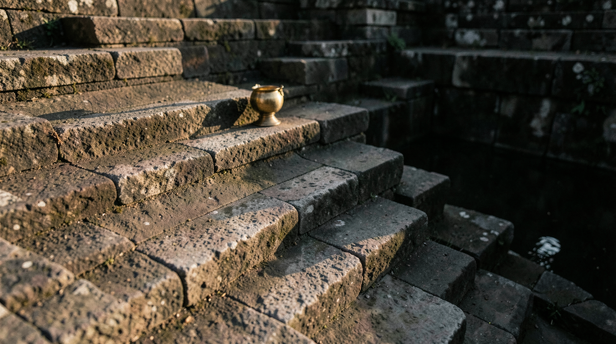
The defining feature of a temple tank is its stepped sides, the ghats that descend in stages from the rim to the waterline. These are not decorative. They exist because the water level changes across seasons, and a worshipper must be able to reach the water regardless of whether it is at its monsoon high or its summer low. The steps guarantee access at every level.
The number of steps varies by temple and by tradition, but the descent is always gradual and always public. There are no private approaches. Everyone who enters the water enters the same way, from the same steps, in the same sight of the other worshippers and of the temple tower reflected in the water. That visibility is part of the design. The tank is a communal threshold, not a private bath.
In some traditions, the tank is called a pushkarini, meaning a place where the lotus grows. In others it is a teertham, a word that means both a crossing point and a sacred ford. The same word is used for the rivers where pilgrims gather, which tells you something about what the tank was understood to be: a river made still, a tirtha brought inside the temple boundary so that those who could not travel to a sacred river could still reach its equivalent.
What the Water Is Used For
![Ritual Vessel and Lamp]()
Ritual Vessel and Lamp
Image credit : MyLifeXP Bureau
The uses of a temple tank are layered, and they do not all belong to the same register. At the most visible level, worshippers bathe before entering the inner sanctum. This is not merely symbolic cleanliness. In the devotional framework that governs temple entry, the body that approaches the deity is supposed to have crossed a threshold, and water is the medium of that crossing. The bath in the tank is the physical act of leaving ordinary time and entering sacred time.
At the ritual level, the tank's water is used in the abhishekam, the bathing of the deity's image with water, milk, and other offerings. In many temples, the tank water is considered especially charged for this purpose because it has been consecrated along with the temple itself at the time of the kumbhabhishekam, the consecration ceremony that is renewed periodically. The water is not treated as ordinary water; it is treated as a participant in the ritual.
The tank also hosts the theerthavari, a festival rite in which the processional image of the deity is brought to the water and immersed or floated on a raft. This is one of the most visually arresting moments in a temple calendar: the deity, normally housed in the dim interior of the sanctum, brought out into open sky and placed on water, surrounded by lamps and music. The tank makes this possible. A temple without a tank cannot perform the theerthavari in the traditional form.
Where the Tank Sits and Why That Position Was Chosen
In the classical layout described in the Manasara and the Mayamata, two foundational texts on sacred architecture, the tank is placed to the north or northeast of the main sanctum. The northeast is considered the direction of Ishanya, associated with water and with the divine in several Agamic frameworks. Placing the tank there is not arbitrary; it follows the same directional logic that determines where the kitchen, the flagpole, and the subsidiary shrines are placed.
In practice, geography sometimes overrides the ideal. A temple built on a hillside, or constrained by an existing settlement, may have its tank to the south or the west. What does not change is the requirement that the tank be within the prakara, the enclosing wall, and that it be reachable from the main path of circumambulation. The worshipper who walks the pradakshina, the clockwise circuit around the sanctum, passes the tank as part of that circuit. The water is not a detour; it is on the path.
What Happens to a Temple When the Tank Is Neglected
Across India, many temple tanks have silted, shrunk, or been built over as the settlements around them expanded. The consequences are not only ritual. Temple tanks in their working form functioned as rainwater harvesting systems. Their stepped sides allowed water to percolate slowly into the ground rather than run off. The tanks of Kanchipuram, Madurai, and Srirangam were large enough to serve the surrounding town's water needs in dry months, not only the temple's ritual needs. When a tank silts, that recharge function disappears along with the ritual one.
Several temple administrations and state archaeology departments have undertaken desilting programmes over the past few decades. The process is slow and expensive, but the tanks that have been restored, the Sivaganga tank at the Brihadeeswarar temple in Thanjavur is one example, have recovered both their water level and their ritual use within a few seasons of restoration. The tank, it turns out, does not need much to come back. It needs the silt removed and the inlet channels cleared. The rest it does on its own.
The tank was never a luxury attached to a temple. It was part of the temple's working logic, the place where the worshipper crossed from one state to another, where the deity met the open sky, where the rain that fell on the gopuram eventually came to rest. Its position was chosen before the walls went up because the water came first, and the temple was built around what the water made possible.
Unlock insightful tips and inspiration on personal growth, productivity, and well-being. Stay motivated and updated with the latest at
My Life XP.