Why Did Kaundinya Lose Everything? Anant Vrat Story
Noopur Kumari | Sept 22, 2026, 12:00 IST
What happened when a sage threw away the sacred thread that had brought prosperity into his home? The answer lies at the heart of the Anant Chaturdashi story. Sushila learns the Anant Vrat from a group of women and ties the 14-knotted Anant Sutra. Her household soon prospers, but her husband Kaundinya becomes doubtful and tears the thread away.

<strong>Anant Chaturdashi vrat katha</strong>,
Image credit : ChatGPT(ai)
A simple thread with 14 knots may look ordinary, but according to the traditional Anant Chaturdashi vrat katha, it carries a much deeper meaning. The story is about Sushila, Sage Kaundinya and Lord Ananta, the infinite form of Lord Vishnu. It begins with faith, turns into prosperity, takes a painful turn because of pride and finally becomes a story of repentance and redemption. The same vrat is also linked in tradition with the Pandavas, after Lord Krishna advised Yudhishthira to observe it during their difficult exile.
![Sushila Learning About Anant Vrat]()
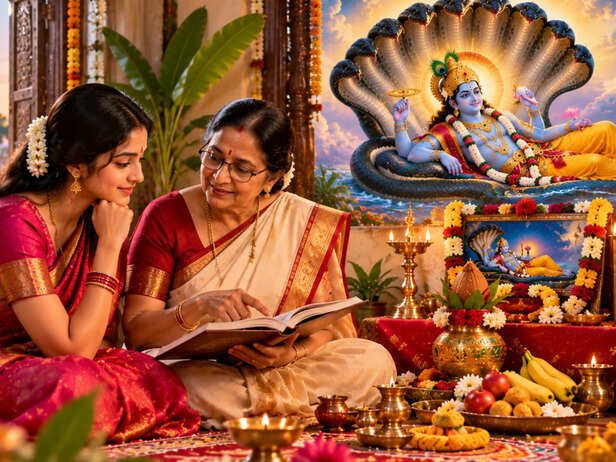
The traditional Anant Chaturdashi vrat katha begins with Sushila, the daughter of a righteous Brahmin named Sumanta. After her marriage to Sage Kaundinya, the couple began their journey toward the sage's ashrama. One day, while they stopped near a river, Sushila noticed a group of women performing a special worship. Curious, she asked them about the ritual. They told her about Anant Vrat, dedicated to Lord Ananta, and explained the significance of the sacred thread. Sushila listened with faith, performed the ritual and tied the Anant Sutra containing 14 knots around her arm.
![Sushila Tying the Anant Sutra]()
After completing the Anant Vrat, Sushila returned to her husband with the sacred thread still tied around her arm. According to the traditional story, prosperity soon entered their household. Their life changed from hardship to comfort, and abundance appeared to follow. For Sushila, the change was connected with her sincere faith in Lord Ananta. But Kaundinya saw things differently. He questioned how an ordinary-looking thread could be responsible for their good fortune. His doubt slowly turned into pride, setting up the most important moment in the Anant Chaturdashi vrat story.
Kaundinya refused to accept that the Anant Sutra had any connection with their prosperity. In anger, he tore the thread from Sushila's hand and threw it into the fire. The act was not presented merely as destroying a piece of string. In the story, it represented disrespect toward Lord Ananta and the faith behind the ritual. Soon afterward, their prosperity disappeared and the couple was left facing hardship again. The dramatic change gives the Anant Chaturdashi story its central lesson: faith without humility can easily be overshadowed by pride and arrogance.
When Kaundinya realised what had happened, he understood that his own actions had brought him into this difficult situation. Filled with regret, he went into the forest searching for Lord Ananta. His journey became increasingly difficult, and eventually he collapsed from exhaustion. Yet the traditional Anant Vrat Katha does not end with punishment. At his lowest point, Kaundinya encountered a mysterious elderly Brahmin, who was actually Lord Ananta in disguise. The divine encounter gave the sage an opportunity to understand his mistake and seek redemption rather than remain trapped in regret.
Lord Ananta eventually revealed Himself to Kaundinya and explained why the sage had suffered. The message was not simply about losing wealth. Kaundinya had allowed pride to replace faith and had disrespected the Anant Sutra without understanding its spiritual significance. Lord Ananta instructed him to return home and observe the Anant Vrat sincerely for fourteen years, according to the traditional account. The sage followed the instruction with humility. His story therefore moves from prosperity to arrogance, from downfall to repentance, and finally toward peace. That transformation is the heart of the Anant Chaturdashi significance.
The Anant Sutra is one of the most recognisable symbols of Anant Chaturdashi. Traditional observances describe it as a sacred thread containing 14 knots, which are associated with the fourteen worlds of Hindu cosmology. Devotees traditionally tie the thread after worshipping Lord Ananta. The number 14 therefore gives the ritual a symbolic dimension beyond its physical form. A small thread becomes a reminder of the vastness associated with Ananta, or the infinite. For devotees, tying it can represent faith, protection, continuity and a commitment to remain spiritually steady through changing circumstances.
The story of Anant Vrat is also connected with the Mahabharata. According to the traditional account, after the Pandavas lost their kingdom and entered exile, Yudhishthira asked Lord Krishna how they could overcome their difficulties. Krishna advised him to observe the Ananta Vrat and then narrated the story of Sushila and Kaundinya. The tradition says that Yudhishthira followed Krishna's advice and that the Pandavas eventually regained their kingdom. The connection adds another layer to the festival: when circumstances seem uncertain, devotion is presented as a way of finding steadiness and hope.
Unlock insightful tips and inspiration on personal growth, productivity, and well-being. Stay motivated and updated with the latest at My Life XP
The Story Begins With Sushila
Sushila Learning About Anant Vrat
Image credit : ChatGPT (ai)
The traditional Anant Chaturdashi vrat katha begins with Sushila, the daughter of a righteous Brahmin named Sumanta. After her marriage to Sage Kaundinya, the couple began their journey toward the sage's ashrama. One day, while they stopped near a river, Sushila noticed a group of women performing a special worship. Curious, she asked them about the ritual. They told her about Anant Vrat, dedicated to Lord Ananta, and explained the significance of the sacred thread. Sushila listened with faith, performed the ritual and tied the Anant Sutra containing 14 knots around her arm.
Prosperity Soon Enters Their Home

Sushila Tying the Anant Sutra
Image credit : chatgpt(ai)
After completing the Anant Vrat, Sushila returned to her husband with the sacred thread still tied around her arm. According to the traditional story, prosperity soon entered their household. Their life changed from hardship to comfort, and abundance appeared to follow. For Sushila, the change was connected with her sincere faith in Lord Ananta. But Kaundinya saw things differently. He questioned how an ordinary-looking thread could be responsible for their good fortune. His doubt slowly turned into pride, setting up the most important moment in the Anant Chaturdashi vrat story.
Kaundinya Makes One Costly Mistake
He Went Into the Forest
Ananta Reveals the Real Lesson
Why Does the Thread Have 14 Knots?
Krishna Also Told Yudhishthira
Unlock insightful tips and inspiration on personal growth, productivity, and well-being. Stay motivated and updated with the latest at My Life XP