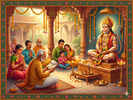
Imagine entering a home during the Diwali season and finding pens, notebooks, inkpots and business account books arranged for a religious ceremony. Instead of being used for writing, these everyday objects are decorated with flowers and worshipped.
This unusual tradition is known as
Kalam-Dawat Puja, and it is associated with Lord Chitragupta, the divine keeper of human deeds.
Observed on Kartik Shukla Dwitiya, the same day as Bhai Dooj, Chitragupta Puja holds special importance among Kayastha families. While most people associate Bhai Dooj with sisters applying tilak to their brothers, this tradition introduces another fascinating story from Hindu mythology.
But who is Lord Chitragupta, and why are pens and account books considered sacred during his worship?
Who Is Lord Chitragupta in Hindu Mythology?
![Pens and Books Become Sacred on Bhai Dooj]()
Pens and Books Become Sacred on Bhai Dooj
Image credit : ChatGPT
According to Hindu tradition, Lord Chitragupta is responsible for recording the good and bad deeds of every human being. He serves Yama, the god of death, and maintains the records that help determine the consequences of a person's actions after death.His role is not simply that of a divine accountant. He represents the belief that every action matters, whether it is performed publicly or in private.The story of his birth is equally interesting and connects him with Lord Brahma, the creator of the universe.
How Was Lord Chitragupta Born? The Story of Brahma and Yama
A popular mythological account says that Yama once approached Lord Brahma with a difficult problem.As the number of living beings increased, keeping track of everyone's actions became an enormous responsibility. Yama needed someone who could carefully record the deeds of every person and present those records when required.
Understanding his concern, Brahma began meditating. According to the traditional story, a divine figure emerged from his body, holding a pen and an inkpot.Brahma named him Chitragupta and entrusted him with the responsibility of maintaining the records of human actions.
The name Chitragupta is traditionally associated with the idea of a hidden or carefully maintained record. Since he is believed to have emerged from Brahma's
kaya, meaning body, the Kayastha community traditionally regards him as its ancestral deity.This is why his worship is closely connected with writing, documentation and record-keeping.
Why Is Chitragupta Puja Celebrated on Bhai Dooj?
To understand the timing of this worship, we must look at the traditional story of Bhai Dooj.According to a popular legend, Yama once visited his sister Yamuna after a long time. She welcomed him warmly, applied tilak to his forehead and prepared a special meal for him.Touched by her affection, Yama offered her a blessing. He declared that brothers who visited their sisters on this auspicious day and received their blessings would enjoy well-being and protection.This occasion became associated with Yama Dwitiya, which is also celebrated as Bhai Dooj.
Chitragupta Puja is observed on the same lunar day, particularly by Kayastha families, because of Chitragupta's close association with Yama.However, the two traditions have different meanings. Bhai Dooj celebrates the bond between brothers and sisters, while Chitragupta Puja honours the divine record-keeper and reminds people to live honestly.
What Is Kalam-Dawat Puja and Why Is It Important?
One of the most distinctive rituals associated with Chitragupta Puja is the worship of pens, inkpots and account books. The practice is popularly known as Kalam-Dawat Puja.The ritual is connected with Chitragupta's responsibility of recording human deeds. His pen and inkpot symbolise knowledge, writing, learning and accountability.
During the puja, families commonly:
- Place pens, notebooks, inkpots and account books before the deity.
- Decorate the prayer area with flowers, lamps and traditional offerings.
- Write prayers or the name of Lord Chitragupta.
- Seek blessings for wisdom, education, honest work and professional success.
Some business families also worship their account books and pray for fair dealings and prosperity in the coming year.
For students, writers, teachers, accountants and business owners, the ritual carries a special message: knowledge and professional skills should always be accompanied by honesty.
Why Is Lord Chitragupta Important to the Kayastha Community?
Lord Chitragupta is traditionally regarded as the ancestral deity of the Kayastha community.Community traditions connect his birth from Brahma's body with the origin of the Kayasthas. Historically, many members of this community worked as writers, record-keepers, administrators and accountants.
This association with documentation and administration makes Chitragupta's worship particularly meaningful.For many Kayastha families, the annual puja is not just a religious ceremony. It is also an opportunity to remember their cultural heritage, honour knowledge and seek blessings for responsible work.
The Deeper Message Behind Chitragupta Puja
The most meaningful lesson in Chitragupta's story is that every action has consequences.People often focus on visible achievements, money and professional success. However, this tradition reminds devotees that how they achieve those things matters just as much.It encourages people to be truthful in their work, thoughtful in their words and responsible for their decisions.The worship of pens and books also gives an everyday object a deeper meaning. A pen is not merely a tool for writing. It represents knowledge, responsibility and the ability to make choices.
A Diwali Tradition That Goes Beyond Lakshmi Puja
Diwali is widely associated with Goddess Lakshmi, prosperity and new beginnings. But Chitragupta Puja adds another dimension to the festive season.While Lakshmi is worshipped for prosperity, Chitragupta represents the importance of using one's knowledge, wealth and abilities responsibly.His story reminds us that success is not measured only by what we earn or achieve. Our honesty, intentions and actions also matter.That is perhaps the most valuable lesson hidden behind this lesser-known Bhai Dooj tradition.
Unlock insightful tips and inspiration on personal growth, productivity, and well-being. Stay motivated and updated with the latest at
My Life XP.