Why Does Karna’s Tree in Surat Have Only 3 Leaves?
Noopur Kumari | Oct 02, 2026, 15:00 IST
Karna’s death is one of the most emotional episodes in the Mahabharata, but the story does not end with his funeral. A local tradition in Surat connects Karna’s final wish to a mysterious tree said to grow with only three leaves. Why three? What did Krishna supposedly promise the Pandavas? And why do devotees connect the leaves with the Hindu Trinity?

tree near the Tapi River was believed to carry a secret
Image credit : ChatGPT(ai)
What if a tree near the Tapi River was believed to carry a secret connected to one of the Mahabharata’s most famous warriors? In Surat, a local religious tradition links a sacred site known as Karna’s Samadhi with a remarkable three-leaf tree. According to the traditional story, Lord Krishna chose this spot for Karna’s final rites because it was believed to be untouched land. The story says that Krishna then promised the Pandavas that a tree with only three leaves would remain as a sign of the sacred place. Even today, devotees connect those three leaves with Brahma, Vishnu and Mahesh.
![Krishna Reveals Karna’s True Identity]()
According to the traditional Mahabharata-linked story, Karna wanted his final rites to be performed on untouched land. The idea of “virgin land” in this local account refers to a place believed to have remained untouched by human presence. After Karna’s death in the Kurukshetra war, Krishna is said to have searched for such a place. The story connects that search with the banks of the Tapi River in present-day Surat. This forms the foundation of the Karna Samadhi story, where devotees remember Karna not only as a warrior but also as a symbol of generosity, loyalty and sacrifice.
![Karna Rejects the Promise of Kingship]()
The story takes an unusual turn when Krishna supposedly finds the required untouched land near the Tapi River. According to the local tradition, Karna’s body was brought to this place for the final rites. The Pandavas then wondered how future generations would know that this was the same sacred land chosen for Karna. This question becomes the key moment in the Mahabharata story of Karna’s Samadhi. The answer attributed to Krishna is what gives the site its most famous tradition: a tree that would remain different from ordinary trees.
According to the traditional account, Krishna told the Pandavas that a tree would remain at the spot as a sign of its sacred connection with Karna. The tree is said to produce only three leaves, making it a distinctive part of the local belief surrounding Karna’s Samadhi in Surat. These three leaves are traditionally associated with Brahma, Vishnu and Mahesh, representing creation, preservation and transformation. Whether viewed as a religious symbol or a fascinating local tradition, the three-leaf tree has become closely connected with the story of Karna and the Mahabharata.
The number three carries deep symbolism in Hindu traditions, which is why the three leaves are especially meaningful to devotees. In the local belief surrounding the Karna three-leaf tree, they represent Brahma, Vishnu and Mahesh, commonly understood as the divine forces of creation, preservation and transformation. This interpretation gives the tree a spiritual meaning beyond its unusual appearance. For devotees visiting the Karna temple and Samadhi tradition in Surat, the leaves are therefore remembered not simply as part of a tree, but as a reminder of the sacred story associated with Karna’s final rites.
The Tapi River adds another important layer to the story. The river has long been an important part of Surat’s cultural and religious landscape, and local tradition connects its banks with Karna’s Samadhi. According to the story, this was the place where Krishna found the untouched ground needed for Karna’s final rites. Over generations, the location became associated with remembrance, devotion and the Karna Mahabharata story. For visitors, the appeal lies not only in the tree but also in the larger story of Karna, whose life is remembered for his generosity, courage and complicated place in the Mahabharata.
The site is also associated with a popular belief that prayers and wishes made there can receive divine blessings. This is a matter of faith rather than something that can be scientifically established. For devotees, however, the emotional importance of Karna’s Samadhi in Surat comes from remembering a figure who continued to give despite facing hardship. The story encourages reflection on generosity, duty and sacrifice. Rather than focusing only on the mystery of the three leaves, visitors can also see the place as a reminder of the values traditionally associated with Karna in the Mahabharata.
The three-leaf tree has become a memorable part of the local tradition surrounding Karna’s Samadhi and the Mahabharata. The exact age of the tree and the claim that it has produced only three leaves for thousands of years are not independently established historical facts, so they are best understood as part of the sacred tradition. Yet the story continues to attract attention because it connects a physical place with one of India’s most enduring epics. Whether someone visits as a devotee, a history enthusiast or simply a curious traveller, the story offers a powerful reminder of how mythology and local traditions continue to shape India’s cultural landscape.
Unlock insightful tips and inspiration on personal growth, productivity, and well-being. Stay motivated and updated with the latest at My Life XP.
Karna’s Final Wish
Krishna Reveals Karna’s True Identity
Image credit : chatgpt(ai)
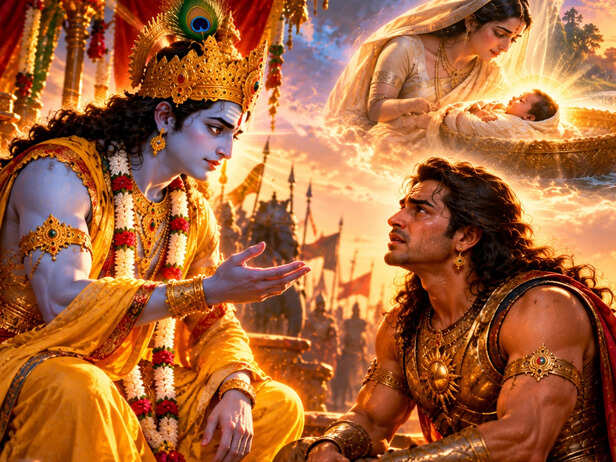
According to the traditional Mahabharata-linked story, Karna wanted his final rites to be performed on untouched land. The idea of “virgin land” in this local account refers to a place believed to have remained untouched by human presence. After Karna’s death in the Kurukshetra war, Krishna is said to have searched for such a place. The story connects that search with the banks of the Tapi River in present-day Surat. This forms the foundation of the Karna Samadhi story, where devotees remember Karna not only as a warrior but also as a symbol of generosity, loyalty and sacrifice.
Krishna Found the Sacred Spot
Karna Rejects the Promise of Kingship
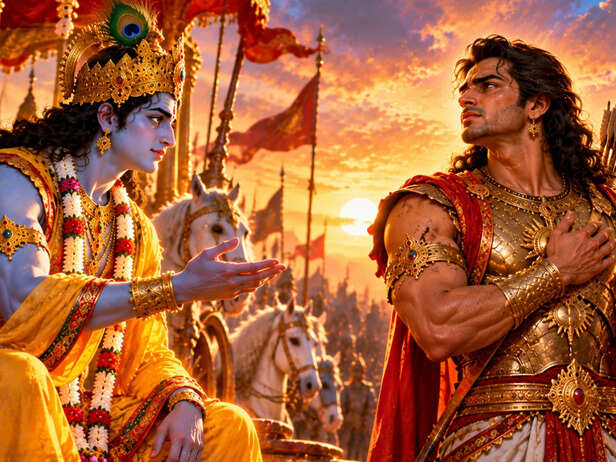
The story takes an unusual turn when Krishna supposedly finds the required untouched land near the Tapi River. According to the local tradition, Karna’s body was brought to this place for the final rites. The Pandavas then wondered how future generations would know that this was the same sacred land chosen for Karna. This question becomes the key moment in the Mahabharata story of Karna’s Samadhi. The answer attributed to Krishna is what gives the site its most famous tradition: a tree that would remain different from ordinary trees.
The Promise of Three Leaves
Why Are There Three Leaves?
The Tapi River Connection
Why Devotees Visit the Place
A Story That Still Lives On
Unlock insightful tips and inspiration on personal growth, productivity, and well-being. Stay motivated and updated with the latest at My Life XP.