Why Ganesha Got an Elephant Head: The Shocking Meaning
Noopur Kumari | Sept 21, 2026, 15:00 IST
The most familiar version of the Ganesha birth story focuses on Shiva, Parvati and the beheading of Ganesha. But the deeper question is: why was his head replaced with that of an elephant? And why do traditions connect Ganesha with wisdom and intellect? A philosophical interpretation sees the story as a movement from limited self-identity to higher consciousness.

Ganesha’s Head Wasn’t Just a Myth
Image credit : CHATGPT(AI)
We have all heard the story of how Lord Shiva cut off Ganesha’s head and later gave him an elephant’s head. But what if this famous Ganesha birth story is pointing towards something much deeper than a family conflict? In a Vedantic reading, the story can be understood as a symbolic journey from ego and limited identity towards higher awareness. Ganesha, created by Mata Parvati, represents the individual identity formed within nature, while Shiva represents pure consciousness. Seen this way, the story of Lord Ganesha’s elephant head becomes a powerful lesson about ego, ignorance, knowledge and transformation.
![Lord Ganesha's 9 Body Parts Hide Powerful Life Lessons]()
In several Purāṇic traditions, Ganesha is created by Mata Parvati and placed at the entrance while she bathes. The Shiva Purana describes Parvati creating a son from material associated with her body and giving him instructions to guard the entrance. Symbolically, this can be read as the individual self emerging from nature, or prakriti. The child knows only the command given to him and faithfully protects the boundary. This creates the first layer of the Ganesha symbolism: a limited identity can become so attached to its role that it fails to recognise something greater standing before it.
![Morya Gosavi is known to be a devout follower of Lord Ganesha and has lived]()
When Shiva arrives, Ganesha refuses to let him enter because he is following his mother’s instruction. The two then confront each other, leading to the moment when Shiva cuts off Ganesha’s head. The Skanda Purana also preserves a version in which Ganesha blocks Shiva and Shiva strikes his head with his trident. A Vedantic interpretation turns this dramatic moment into something more inward. The conflict can represent the clash between limited identity and higher consciousness. The ego says, “I know who I am,” while spiritual knowledge asks us to question that very assumption.
The most striking part of the Ganesha head story is not simply that his head is removed, but what the head can represent. In a philosophical reading, the head becomes a symbol of the identity through which we think, judge and define ourselves. We often say, “This is who I am,” based on our body, status, knowledge, achievements or opinions. Vedanta describes ignorance, or avidya, as a fundamental misunderstanding of our true nature. The story can therefore be read as a reminder that spiritual growth begins when our rigid identification with the limited self is challenged.
This is where the elephant head of Ganesha becomes especially meaningful. Traditional texts offer different accounts of how Ganesha received his elephant head. In the Shiva Purana, Shiva’s attendants travel north and find a single-tusked elephant whose head is then placed on Ganesha’s body. Later interpretations often connect the elephant with qualities such as strength, intelligence and discernment. So the transformation can be understood symbolically: the old identity is gone, and a broader form of awareness emerges. Ganesha is therefore remembered not merely as the remover of obstacles, but also as a deity associated with wisdom and understanding.
The Ganesha elephant head symbolism becomes even more interesting when viewed alongside the traditional direction of the search. The Shiva Purana specifically describes the attendants going towards the north before finding the elephant. In a symbolic Vedantic reading, north can be understood as an upward or higher direction, representing movement towards greater awareness. This should be treated as a philosophical interpretation rather than the literal explanation given by the Purāṇic narrative. The deeper lesson remains powerful: spiritual transformation requires moving beyond the narrow identity through which we normally see ourselves and opening the mind to a larger understanding.
After his transformation, Ganesha is not remembered as the same child who stood stubbornly at the doorway. He becomes Gajanana, the elephant-faced one, and is honoured as the leader of the ganas. Purāṇic traditions also connect him with the removal of obstacles and worship at the beginning of important activities. This gives the Ganesha symbolism a powerful direction. The goal is not simply to destroy obstacles outside us. Sometimes the biggest obstacle is our own rigid thinking, ego and limited understanding. Ganesha’s transformed form can remind us that real intelligence is not just knowing more, but seeing beyond ourselves.
Perhaps that is why the Ganesha birth story continues to feel relevant. We all create boundaries around ourselves. We identify with our job, appearance, relationships, opinions and achievements, and slowly begin believing that these things completely define us. The story offers a different possibility. The symbolic cutting of the old head can represent letting go of a narrow identity, while the elephant head represents a wider vision. In this reading, Ganesha’s transformation is not about losing oneself. It is about moving from “I know everything” to the humility of recognising that there is always a deeper truth to understand.
Unlock insightful tips and inspiration on personal growth, productivity, and well-being. Stay motivated and updated with the latest at My Life XP.
Ganesha Was Born From Parvati
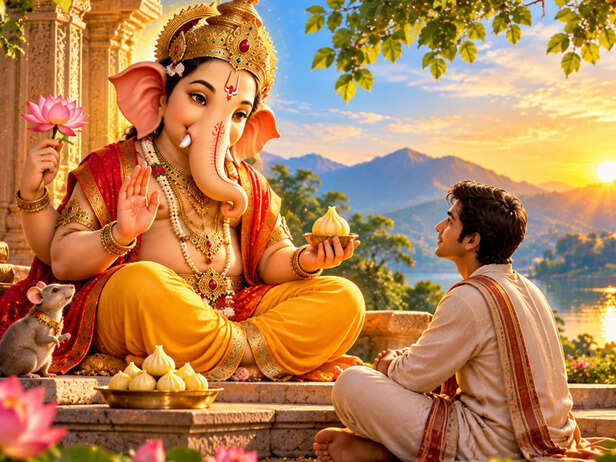
Lord Ganesha's 9 Body Parts Hide Powerful Life Lessons
Image credit : FREEPIK
In several Purāṇic traditions, Ganesha is created by Mata Parvati and placed at the entrance while she bathes. The Shiva Purana describes Parvati creating a son from material associated with her body and giving him instructions to guard the entrance. Symbolically, this can be read as the individual self emerging from nature, or prakriti. The child knows only the command given to him and faithfully protects the boundary. This creates the first layer of the Ganesha symbolism: a limited identity can become so attached to its role that it fails to recognise something greater standing before it.
The Real Conflict Was About Identity
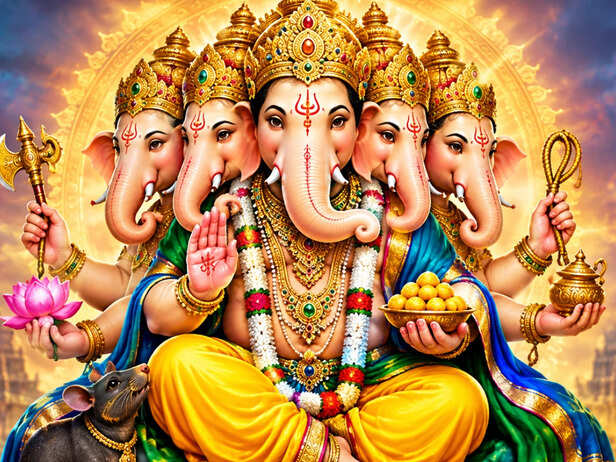
Morya Gosavi is known to be a devout follower of Lord Ganesha and has lived
Image credit : CHATGPT(AI)
When Shiva arrives, Ganesha refuses to let him enter because he is following his mother’s instruction. The two then confront each other, leading to the moment when Shiva cuts off Ganesha’s head. The Skanda Purana also preserves a version in which Ganesha blocks Shiva and Shiva strikes his head with his trident. A Vedantic interpretation turns this dramatic moment into something more inward. The conflict can represent the clash between limited identity and higher consciousness. The ego says, “I know who I am,” while spiritual knowledge asks us to question that very assumption.
The Head Represents the Ego
Why Was an Elephant Head Chosen?
The North Has Another Layer
Ganesha Represents Higher Intelligence
The Story Can Be Read Within Us
Unlock insightful tips and inspiration on personal growth, productivity, and well-being. Stay motivated and updated with the latest at My Life XP.