The Divine Narasimha Mantra That Can Destroy Fear Instantly
Deepak Rajeev | Wed, 06 May 2026
The Narasimha mantra is a powerful chant linked to Lord Vishnu’s fierce avatar, Narasimha. Rooted in the Bhagavata Purana, it symbolizes divine protection and courage. Devotees believe chanting this mantra helps overcome fear, anxiety, and negativity by strengthening inner faith and focus, transforming fear into confidence through spiritual awareness and disciplined devotion over time.

The Boundless Power of Lord Narasimha (Image Credit: AI)
In Hindu mythology, one of the most intense and powerful manifestations of Lord Vishnu is the Narasimha avatar, a half-lion and half-human form believed to appear specifically to destroy injustice and protect true devotees. According to the Bhagavata Purana, this form emerged when the demon king Hiranyakashipu gained a powerful boon that made him nearly invincible and began persecuting his own son Prahlada for his devotion to Vishnu. In a dramatic moment of divine intervention, Vishnu appeared as Narasimha from a pillar to uphold dharma and protect his devotee, showing that divine power often manifests in ways that go beyond human understanding. This story forms the emotional and spiritual foundation behind Narasimha worship, where fear is symbolically replaced with faith, protection, and inner strength.
![Lord Narasimha (Image Credit: AI)]()
The Narasimha mantra tradition is rooted in devotional Vaishnavism, where chanting is seen as a form of surrender and mental purification rather than a magical act. One of the most widely referenced mantras associated with Vishnu in protective worship is:
“Om Namo Bhagavate Narasimhaya”
This mantra is traditionally used by devotees to invoke courage, stability, and spiritual strength. In Hindu practice, chanting mantras associated with Narasimha is believed to help individuals overcome emotional fear, anxiety, and mental distress by focusing the mind on divine protection rather than external uncertainty. The significance lies not in instant physical change, but in the psychological and spiritual discipline that repeated chanting builds over time.
![Lord Narasimha With Lakshmi Devi (Image Credit: AI)]() The symbolism of Narasimha is central to understanding why his mantra is linked with fearlessness. Unlike peaceful forms of Vishnu, Narasimha represents controlled divine anger used strictly for restoring balance and protecting righteousness. In scriptural accounts, this form appears specifically when cosmic injustice reaches its peak, showing that divine protection can take fierce forms when needed. Because of this symbolism, devotees believe that chanting his mantra helps them mentally confront fear, similar to how Prahlada remained fearless despite extreme adversity. The emphasis is not on external destruction of fear, but on internal transformation of courage.
The symbolism of Narasimha is central to understanding why his mantra is linked with fearlessness. Unlike peaceful forms of Vishnu, Narasimha represents controlled divine anger used strictly for restoring balance and protecting righteousness. In scriptural accounts, this form appears specifically when cosmic injustice reaches its peak, showing that divine protection can take fierce forms when needed. Because of this symbolism, devotees believe that chanting his mantra helps them mentally confront fear, similar to how Prahlada remained fearless despite extreme adversity. The emphasis is not on external destruction of fear, but on internal transformation of courage.
In traditional Hindu philosophy, chanting a mantra like Narasimha’s is considered a form of “japa,” a meditative repetition that gradually calms the mind and builds focus. It is often practiced during moments of emotional instability or spiritual seeking, with the belief that repetition helps align thoughts with higher consciousness. The idea of “destroying fear instantly” is therefore understood symbolically, meaning the gradual weakening of fear through consistent devotion and mental discipline rather than an immediate physical effect. Many spiritual traditions interpret this process as a shift from anxiety-driven thinking to faith-driven awareness.
The Narasimha form remains one of the most powerful symbols of protection in Hindu tradition, and temples dedicated to him are found across India where devotees continue to chant his mantras as part of daily worship. Across centuries, the narrative of Prahlada and Narasimha has remained a reminder that devotion and truth are believed to be stronger than fear and oppression. The enduring popularity of Narasimha worship shows how deeply the idea of divine protection is embedded in cultural memory, where faith becomes a source of psychological strength in everyday life.
The Narasimha mantra tradition ultimately reflects a larger spiritual principle rather than a literal promise. It represents the idea that fear is not removed by force, but by shifting awareness toward something greater than the fear itself. In this sense, the divine Narasimha form of Vishnu continues to serve as a timeless symbol of courage, protection, and unwavering devotion.
Unlock insightful tips and inspiration on personal growth, productivity, and well-being. Stay motivated and updated with the latest at My Life XP.
What Makes the Narasimha Mantra Spiritually Significant
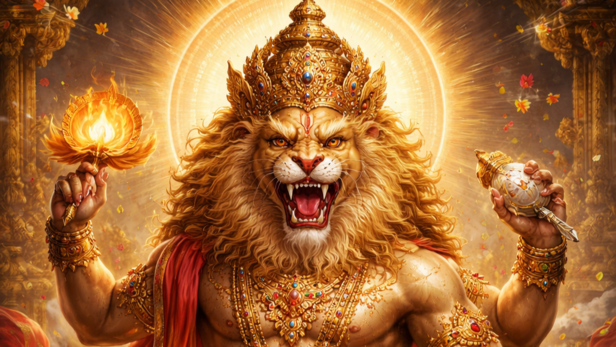
Lord Narasimha (Image Credit: AI)
The Narasimha mantra tradition is rooted in devotional Vaishnavism, where chanting is seen as a form of surrender and mental purification rather than a magical act. One of the most widely referenced mantras associated with Vishnu in protective worship is:
“Om Namo Bhagavate Narasimhaya”
This mantra is traditionally used by devotees to invoke courage, stability, and spiritual strength. In Hindu practice, chanting mantras associated with Narasimha is believed to help individuals overcome emotional fear, anxiety, and mental distress by focusing the mind on divine protection rather than external uncertainty. The significance lies not in instant physical change, but in the psychological and spiritual discipline that repeated chanting builds over time.
Why Narasimha Is Associated With Fear Removal
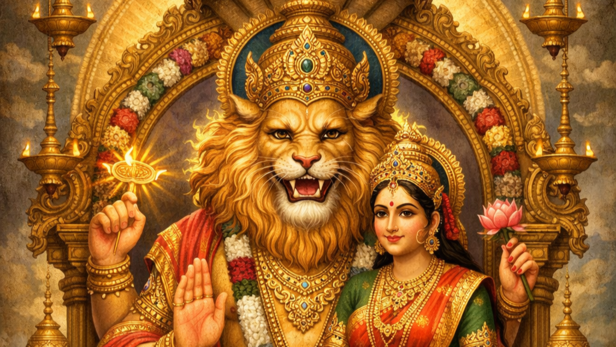
Lord Narasimha With Lakshmi Devi (Image Credit: AI)
The Spiritual Meaning Behind Chanting the Mantra
In traditional Hindu philosophy, chanting a mantra like Narasimha’s is considered a form of “japa,” a meditative repetition that gradually calms the mind and builds focus. It is often practiced during moments of emotional instability or spiritual seeking, with the belief that repetition helps align thoughts with higher consciousness. The idea of “destroying fear instantly” is therefore understood symbolically, meaning the gradual weakening of fear through consistent devotion and mental discipline rather than an immediate physical effect. Many spiritual traditions interpret this process as a shift from anxiety-driven thinking to faith-driven awareness.
A Symbol of Courage That Continues Across Generations
The Narasimha form remains one of the most powerful symbols of protection in Hindu tradition, and temples dedicated to him are found across India where devotees continue to chant his mantras as part of daily worship. Across centuries, the narrative of Prahlada and Narasimha has remained a reminder that devotion and truth are believed to be stronger than fear and oppression. The enduring popularity of Narasimha worship shows how deeply the idea of divine protection is embedded in cultural memory, where faith becomes a source of psychological strength in everyday life.
Conclusion: Fearlessness as Inner Transformation
The Narasimha mantra tradition ultimately reflects a larger spiritual principle rather than a literal promise. It represents the idea that fear is not removed by force, but by shifting awareness toward something greater than the fear itself. In this sense, the divine Narasimha form of Vishnu continues to serve as a timeless symbol of courage, protection, and unwavering devotion.
Unlock insightful tips and inspiration on personal growth, productivity, and well-being. Stay motivated and updated with the latest at My Life XP.