What Happens When Brahma Completes 100 Years?
Noopur Kumari | Jun 24, 2026, 15:00 IST
Ancient Hindu texts describe time as a repeating cycle rather than a straight line. Through Yugas, Manvantaras, and Kalpas, the universe continuously moves through creation, preservation, and dissolution. The most fascinating question is: where are we right now in this cosmic cycle? The answer reveals a breathtaking vision of time that stretches far beyond human imagination.

What if everything you know about time is incomplete? For most of us, time is measured in seconds, hours, days, and years. But according to ancient Hindu scriptures, human time is only a tiny fragment of a much larger cosmic clock. A clock so vast that a single day of Brahma, the creator of the universe, lasts 4.32 billion human years. Even more astonishing, the Ramayana, Mahabharata, and our present age all occupy specific positions within this enormous cosmic timeline. Once you understand this ancient concept, your perspective on life, history, and existence may never be the same again.
![Cosmic Wheel of Time]()
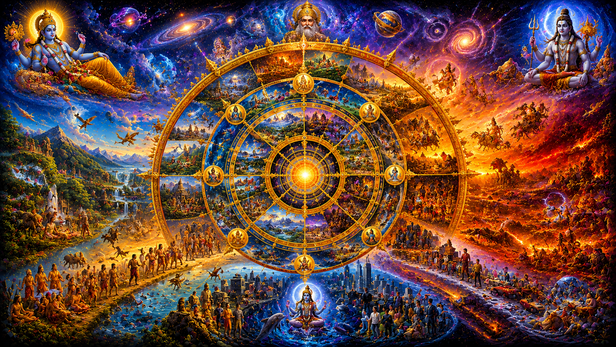
Unlike modern calendars that move from past to future in a straight path, Hindu scriptures describe time as circular. Creation, preservation, and dissolution occur repeatedly in an eternal rhythm. Every event is part of a larger cosmic pattern. This idea transforms how we view existence. Instead of seeing life as a single journey, the scriptures present reality as an infinite cycle of beginnings and endings. The universe itself breathes through these cycles, expanding and contracting over unimaginable periods, governed by divine cosmic laws that operate far beyond human perception.
![Brahma's Divine Day]()
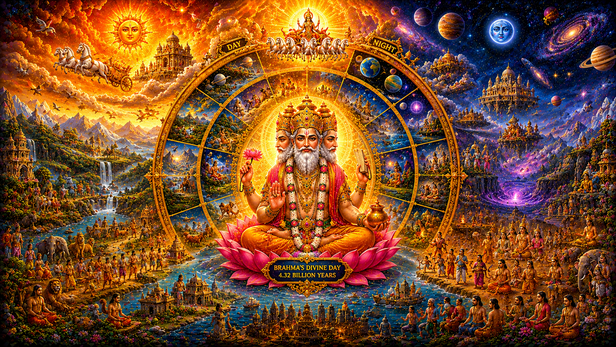
According to Hindu cosmology, one day of Brahma, known as a Kalpa, lasts 4.32 billion years. His night is equally long. Together, a full day and night span 8.64 billion human years. During Brahma's day, creation flourishes across countless worlds. During his night, much of creation enters a dormant state. This scale is so enormous that entire civilizations, species, and even planets appear and disappear within a fraction of a single divine day. The concept reminds us how small human history is compared to cosmic time.
![The Cycle of Four Yugas]()
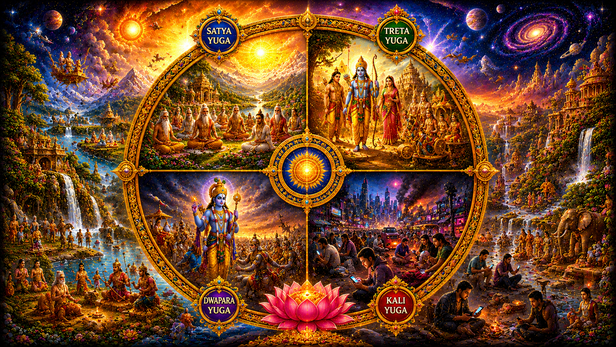
The foundation of cosmic time lies in four ages known as Yugas. Satya Yuga represents truth and spiritual perfection. Treta Yuga witnesses the gradual decline of righteousness. Dwapara Yuga sees increasing conflict and division. Kali Yuga, the current age, is marked by confusion, materialism, and moral challenges. Together, these four ages form a Mahayuga lasting 4.32 million years. Each Yuga teaches unique lessons about human nature, spirituality, and the eternal struggle between dharma and adharma.
A Kalpa is divided into fourteen Manvantaras. Each Manvantara has its own Manu, Indra, and group of Saptarishis who guide creation during that era. Think of it as a complete administrative cycle of the universe. When one Manvantara ends, another begins with new guardians and new cosmic responsibilities. This fascinating structure suggests that creation is continuously renewed and reorganized. The universe is not static; it constantly evolves through carefully ordered stages spanning hundreds of millions of years.
Ancient texts state that we currently live in the seventh Manvantara, known as Vaivasvata Manvantara. Within it, we are in the 28th Mahayuga and specifically in Kali Yuga. This means six Manvantaras have already passed before our present era began. From a cosmic perspective, humanity occupies only a tiny moment within a much larger story. Yet this small chapter carries immense significance because it is believed to be a period of spiritual testing, transformation, and self-discovery.
Many people read the Ramayana and Mahabharata as historical or spiritual narratives. Hindu cosmology places them within specific Yugas. The Ramayana is traditionally associated with Treta Yuga, while the Mahabharata occurred near the end of Dwapara Yuga, just before Kali Yuga began. This means these epics are not isolated stories but milestones within a grand cosmic framework. Their characters, battles, and teachings reflect the changing moral and spiritual conditions of humanity across different ages.
What Happens When Brahma Reaches
The scriptures describe Brahma's lifespan as 100 divine years, equivalent to approximately 311 trillion human years. When this unimaginable period ends, the universe undergoes Mahapralaya, the great dissolution. Worlds, galaxies, and dimensions merge back into the cosmic source. Yet this is not a permanent ending. From that silence emerges a new creation, a new Brahma, and a new cosmic cycle. The message is profound: endings are never final. They are simply gateways to new beginnings.
Unlock insightful tips and inspiration on personal growth, productivity, and well-being. Stay motivated and updated with the latest at My Life XP.
Q1. How long is one day of Brahma?
One day of Brahma, called a Kalpa, lasts 4.32 billion human years.
Q2. Which Yuga are we living in today?
According to Hindu scriptures, we are currently living in Kali Yuga.
Q3. How many Yugas make one Mahayuga?
Four Yugas—Satya, Treta, Dwapara, and Kali—together form one Mahayuga.
Q4. What is a Manvantara?
A Manvantara is a cosmic age ruled by a Manu and spans approximately 306 million years.
Q5. In which Yugas did the Ramayana and Mahabharata occur?
The Ramayana is associated with Treta Yuga, while the Mahabharata took place near the end of Dwapara Yuga.
The Cosmic Clock Works Differently
Cosmic Wheel of Time
Unlike modern calendars that move from past to future in a straight path, Hindu scriptures describe time as circular. Creation, preservation, and dissolution occur repeatedly in an eternal rhythm. Every event is part of a larger cosmic pattern. This idea transforms how we view existence. Instead of seeing life as a single journey, the scriptures present reality as an infinite cycle of beginnings and endings. The universe itself breathes through these cycles, expanding and contracting over unimaginable periods, governed by divine cosmic laws that operate far beyond human perception.
A Day of Brahma Lasts Billions of Years
Brahma's Divine Day
According to Hindu cosmology, one day of Brahma, known as a Kalpa, lasts 4.32 billion years. His night is equally long. Together, a full day and night span 8.64 billion human years. During Brahma's day, creation flourishes across countless worlds. During his night, much of creation enters a dormant state. This scale is so enormous that entire civilizations, species, and even planets appear and disappear within a fraction of a single divine day. The concept reminds us how small human history is compared to cosmic time.
The Four Yugas Shape Human History
The Cycle of Four Yugas
The foundation of cosmic time lies in four ages known as Yugas. Satya Yuga represents truth and spiritual perfection. Treta Yuga witnesses the gradual decline of righteousness. Dwapara Yuga sees increasing conflict and division. Kali Yuga, the current age, is marked by confusion, materialism, and moral challenges. Together, these four ages form a Mahayuga lasting 4.32 million years. Each Yuga teaches unique lessons about human nature, spirituality, and the eternal struggle between dharma and adharma.
The Mystery of the Fourteen Manvantaras
Where Are We Right Now?
Ramayana and Mahabharata on the Cosmic Timeline
What Happens When Brahma Reaches 100 Years ?
Unlock insightful tips and inspiration on personal growth, productivity, and well-being. Stay motivated and updated with the latest at My Life XP.
Frequently Asked Questions (FAQs)
One day of Brahma, called a Kalpa, lasts 4.32 billion human years.
Q2. Which Yuga are we living in today?
According to Hindu scriptures, we are currently living in Kali Yuga.
Q3. How many Yugas make one Mahayuga?
Four Yugas—Satya, Treta, Dwapara, and Kali—together form one Mahayuga.
Q4. What is a Manvantara?
A Manvantara is a cosmic age ruled by a Manu and spans approximately 306 million years.
Q5. In which Yugas did the Ramayana and Mahabharata occur?
The Ramayana is associated with Treta Yuga, while the Mahabharata took place near the end of Dwapara Yuga.