What If Ravana Faced Narasimha Instead of Lord Ram?
Deepak Rajeev | Mon, 18 May 2026
What if Ravana had faced the terrifying Narasimha Avatar instead of Lord Ram during the battle of Lanka? This devotional article explores the explosive alternate Ramayana scenario, comparing Narasimha’s unstoppable divine fury with Ram’s compassionate dharma. Discover why Vishnu chose Ram’s path of righteousness over immediate destruction, and what Ravana’s fate might have looked like before Vishnu’s fiercest avatar.

Narasimha Avatar in Battle of Lanka (Image Credit: AI)
Among the countless “what if” questions hidden within Hindu mythology, few create as much awe, fear, and devotional curiosity as imagining Ravana facing not Lord Ram, but the terrifying Narasimha Avatar of Lord Vishnu. The very thought feels overwhelming. On one side stands Ravana, the mighty king of Lanka, master of the Vedas, devotee of Lord Shiva, conqueror of worlds, and one of the most powerful beings described in the Ramayana. On the other side stands Narasimha, the fierce half lion, half man incarnation of Vishnu whose divine rage shook the universe itself after the destruction of Hiranyakashipu.
When devotees imagine these two cosmic forces colliding, the question becomes emotionally and spiritually explosive. Would Ravana’s intelligence and power survive even for a moment before Narasimha’s unstoppable fury? Could Lanka itself withstand the terrifying energy of the Ugra Narasimha form? And perhaps most importantly, why did Vishnu choose the calm, disciplined, and dharmic form of Lord Ram to defeat Ravana instead of the terrifying Narasimha Avatar? The answers reveal profound truths about dharma, divine purpose, and the deeper meaning hidden within Vishnu’s avatars.
![Lord Narasimha (Image Credit: AI)]()
Among all Vishnu avatars, Narasimha occupies a uniquely fearsome place in Hindu tradition. Unlike the serene majesty of Lord Ram or the playful wisdom of Lord Krishna, Narasimha represents divine rage unleashed against adharma. The Bhagavata Purana describes Narasimha appearing from a pillar at twilight to protect Prahlada and destroy Hiranyakashipu, whose arrogance had reached unbearable levels. The scene remains one of the most terrifying moments in Hindu mythology.
Narasimha did not arrive as a king, philosopher, or strategist. He arrived as pure divine force. His roar shook the heavens. Even the devas became frightened after Hiranyakashipu’s death because Narasimha’s fury did not immediately calm down. Traditional devotional narratives repeatedly emphasize that the gods themselves hesitated to approach him. Only Prahlada’s devotion and eventually Goddess Lakshmi’s calming presence in certain traditions softened the terrifying energy of the avatar. This is why devotees often see Narasimha not merely as a protector, but as the unstoppable manifestation of divine justice itself.
![Divine Fury (Image Credit: AI)]()
To understand how unimaginable this battle would have been, one must understand Ravana’s true stature in Hindu tradition. Ravana was not merely a villain. He was a brilliant scholar, a master musician, a Shiva bhakta of immense intensity, and a ruler whose knowledge terrified even devas. Sacred traditions describe him as someone who performed severe tapasya for thousands of years to gain boons from Brahma. His power was immense enough to challenge celestial beings and destabilize cosmic balance itself.
Yet Ravana’s downfall came from the same flaw that destroyed many mighty beings in Hindu scriptures: ego. Despite his intelligence and spiritual knowledge, Ravana allowed desire, arrogance, and pride to overpower dharma. His abduction of Sita Devi became the final act that pushed destiny toward destruction. This is why the idea of Ravana facing Narasimha feels spiritually explosive. Both figures represent overwhelming intensity, but in completely opposite directions. Ravana represents ego reaching its peak. Narasimha represents divine fury descending to destroy that ego.
One of the most fascinating aspects of this “what if” scenario is imagining how quickly the Lanka war could have ended. Lord Ram fought according to dharma. Every action in the Ramayana carried moral, spiritual, and kingly discipline. Ram gave Ravana repeated opportunities to return Sita and avoid destruction. Even during battle, Ram followed the codes of righteous warfare. But Narasimha operated differently. Narasimha was not the avatar of diplomacy. He was the avatar of immediate cosmic judgment.
If the Ugra Narasimha form had entered Lanka, many devotional traditions imagine that Ravana’s armies would have collapsed instantly under divine terror alone. The battlefield itself may not have survived the intensity of Narasimha’s rage. The image becomes almost cinematic in devotional imagination. The golden towers of Lanka trembling. Rakshasas fleeing in panic. The sky darkening beneath the roar of the lion faced Vishnu avatar. And Ravana, who feared almost nothing in existence, finally confronting a form of Vishnu driven not by royal restraint, but by primal divine wrath.
Ravana’s Boons Might Not Have Protected Him
Ravana possessed extraordinary protections through boons obtained from Brahma. These protections made him nearly invincible against devas, gandharvas, yakshas, and many celestial beings. But Narasimha’s very existence demonstrates that Vishnu avatars transcend ordinary limitations. Hiranyakashipu too believed himself impossible to kill because of carefully crafted boons. Yet Vishnu manifested precisely in a form that bypassed every condition. Neither man nor beast. Neither day nor night Neither indoors nor outdoors. Neither weapon nor ordinary method. Narasimha destroyed Hiranyakashipu by transcending the logic of the boon itself. This creates a powerful devotional possibility. Many devotees believe Ravana’s protections would also have become meaningless before Narasimha because divine will always surpasses ego driven invincibility.
Why Vishnu Chose Ram Instead of Narasimha
This is perhaps the deepest spiritual question hidden within this entire scenario. If Narasimha could destroy adharma so swiftly, why did Vishnu incarnate as Ram instead? The answer lies in the purpose of the Ramayana itself. The Narasimha Avatar came to demonstrate the terrifying immediacy of divine protection for a devotee like Prahlada. The mission was direct destruction of evil. But the Ram Avatar carried a much larger human lesson.
Lord Ram came to teach:
One of the most fascinating devotional imaginations involves Ravana himself witnessing Narasimha. Ravana feared very little. He challenged devas, disturbed sages, and believed his power could overcome destiny itself. Yet Narasimha was unlike anything Ravana had faced before. Unlike Ram’s calm and composed divine presence, Narasimha radiated uncontrollable cosmic fury. Devotional imagination often portrays Ravana realizing too late that this was not merely another enemy king arriving at Lanka’s gates. This was divine destruction itself taking form. For devotees, this creates enormous emotional intensity because Ravana, who once stood arrogantly before the universe, would finally confront a force capable of shaking even his confidence.
A profound spiritual symbolism emerges from this comparison. Ravana constantly attempted negotiation, manipulation, power projection, and strategic control throughout the Ramayana. He understood politics, warfare, and intimidation. But Narasimha represents the aspect of divinity beyond negotiation. Narasimha arrives when adharma crosses its final limit. This is why Narasimha worship remains deeply powerful among devotees even today. Many believe the avatar destroys hidden negativity, fear, injustice, arrogance, and spiritual darkness with terrifying speed. The comparison with Ravana therefore becomes spiritually meaningful. Ravana symbolizes ego believing itself untouchable. Narasimha symbolizes the moment divine justice finally arrives.
Imagining Ravana facing Narasimha instead of Lord Ram creates one of the most thrilling and emotionally intense “what if” scenarios in Hindu mythology. The battle may have ended almost instantly beneath the overwhelming force of Vishnu’s fiercest avatar. Yet the deeper truth revealed through this comparison is even more powerful. Lord Vishnu did not choose Ram’s form because Narasimha lacked strength. He chose Ram because humanity needed dharma more than destruction. Through Ram, the world learned patience, righteousness, compassion, restraint, sacrifice, and ideal conduct. Through Narasimha, the world learned that divine justice ultimately destroys unbearable arrogance.
Both avatars reveal different dimensions of the same supreme truth. And for countless devotees, imagining Ravana standing before the terrifying fury of Narasimha remains a breathtaking reminder that no ego, however powerful, can stand forever before the will of the divine.
Unlock insightful tips and inspiration on personal growth, productivity, and well-being. Stay motivated and updated with the latest at My Life XP.
When devotees imagine these two cosmic forces colliding, the question becomes emotionally and spiritually explosive. Would Ravana’s intelligence and power survive even for a moment before Narasimha’s unstoppable fury? Could Lanka itself withstand the terrifying energy of the Ugra Narasimha form? And perhaps most importantly, why did Vishnu choose the calm, disciplined, and dharmic form of Lord Ram to defeat Ravana instead of the terrifying Narasimha Avatar? The answers reveal profound truths about dharma, divine purpose, and the deeper meaning hidden within Vishnu’s avatars.
Narasimha Was Not an Ordinary Avatar
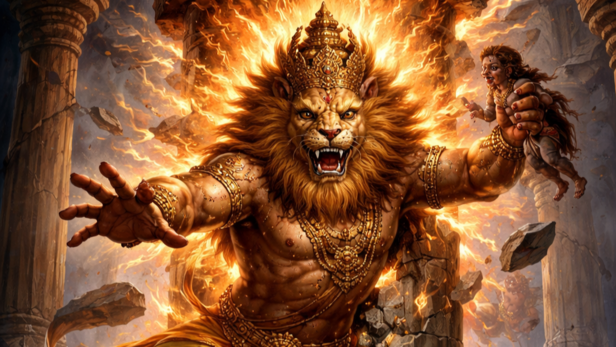
Lord Narasimha (Image Credit: AI)
Among all Vishnu avatars, Narasimha occupies a uniquely fearsome place in Hindu tradition. Unlike the serene majesty of Lord Ram or the playful wisdom of Lord Krishna, Narasimha represents divine rage unleashed against adharma. The Bhagavata Purana describes Narasimha appearing from a pillar at twilight to protect Prahlada and destroy Hiranyakashipu, whose arrogance had reached unbearable levels. The scene remains one of the most terrifying moments in Hindu mythology.
Narasimha did not arrive as a king, philosopher, or strategist. He arrived as pure divine force. His roar shook the heavens. Even the devas became frightened after Hiranyakashipu’s death because Narasimha’s fury did not immediately calm down. Traditional devotional narratives repeatedly emphasize that the gods themselves hesitated to approach him. Only Prahlada’s devotion and eventually Goddess Lakshmi’s calming presence in certain traditions softened the terrifying energy of the avatar. This is why devotees often see Narasimha not merely as a protector, but as the unstoppable manifestation of divine justice itself.
Ravana Was Far More Dangerous Than an Ordinary Demon
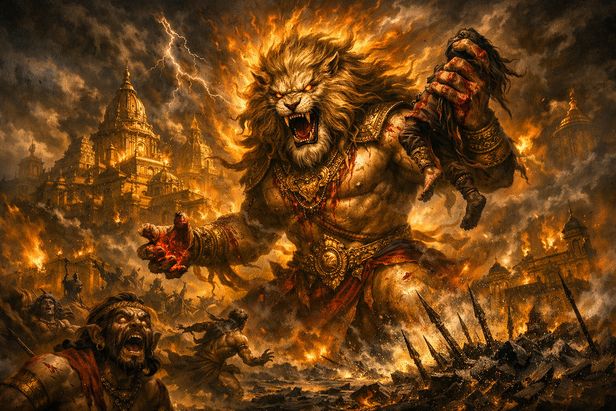
Divine Fury (Image Credit: AI)
To understand how unimaginable this battle would have been, one must understand Ravana’s true stature in Hindu tradition. Ravana was not merely a villain. He was a brilliant scholar, a master musician, a Shiva bhakta of immense intensity, and a ruler whose knowledge terrified even devas. Sacred traditions describe him as someone who performed severe tapasya for thousands of years to gain boons from Brahma. His power was immense enough to challenge celestial beings and destabilize cosmic balance itself.
Yet Ravana’s downfall came from the same flaw that destroyed many mighty beings in Hindu scriptures: ego. Despite his intelligence and spiritual knowledge, Ravana allowed desire, arrogance, and pride to overpower dharma. His abduction of Sita Devi became the final act that pushed destiny toward destruction. This is why the idea of Ravana facing Narasimha feels spiritually explosive. Both figures represent overwhelming intensity, but in completely opposite directions. Ravana represents ego reaching its peak. Narasimha represents divine fury descending to destroy that ego.
If Narasimha Had Entered Lanka, the War Might Have Ended Instantly
One of the most fascinating aspects of this “what if” scenario is imagining how quickly the Lanka war could have ended. Lord Ram fought according to dharma. Every action in the Ramayana carried moral, spiritual, and kingly discipline. Ram gave Ravana repeated opportunities to return Sita and avoid destruction. Even during battle, Ram followed the codes of righteous warfare. But Narasimha operated differently. Narasimha was not the avatar of diplomacy. He was the avatar of immediate cosmic judgment.
If the Ugra Narasimha form had entered Lanka, many devotional traditions imagine that Ravana’s armies would have collapsed instantly under divine terror alone. The battlefield itself may not have survived the intensity of Narasimha’s rage. The image becomes almost cinematic in devotional imagination. The golden towers of Lanka trembling. Rakshasas fleeing in panic. The sky darkening beneath the roar of the lion faced Vishnu avatar. And Ravana, who feared almost nothing in existence, finally confronting a form of Vishnu driven not by royal restraint, but by primal divine wrath.
Ravana’s Boons Might Not Have Protected Him
Ravana possessed extraordinary protections through boons obtained from Brahma. These protections made him nearly invincible against devas, gandharvas, yakshas, and many celestial beings. But Narasimha’s very existence demonstrates that Vishnu avatars transcend ordinary limitations. Hiranyakashipu too believed himself impossible to kill because of carefully crafted boons. Yet Vishnu manifested precisely in a form that bypassed every condition. Neither man nor beast. Neither day nor night Neither indoors nor outdoors. Neither weapon nor ordinary method. Narasimha destroyed Hiranyakashipu by transcending the logic of the boon itself. This creates a powerful devotional possibility. Many devotees believe Ravana’s protections would also have become meaningless before Narasimha because divine will always surpasses ego driven invincibility.
Why Vishnu Chose Ram Instead of Narasimha
This is perhaps the deepest spiritual question hidden within this entire scenario. If Narasimha could destroy adharma so swiftly, why did Vishnu incarnate as Ram instead? The answer lies in the purpose of the Ramayana itself. The Narasimha Avatar came to demonstrate the terrifying immediacy of divine protection for a devotee like Prahlada. The mission was direct destruction of evil. But the Ram Avatar carried a much larger human lesson.
Lord Ram came to teach:
- ideal kingship
- patience
- sacrifice
- compassion
- obedience to dharma
- righteous warfare
- moral leadership
The Emotional Terror Ravana Might Have Felt
One of the most fascinating devotional imaginations involves Ravana himself witnessing Narasimha. Ravana feared very little. He challenged devas, disturbed sages, and believed his power could overcome destiny itself. Yet Narasimha was unlike anything Ravana had faced before. Unlike Ram’s calm and composed divine presence, Narasimha radiated uncontrollable cosmic fury. Devotional imagination often portrays Ravana realizing too late that this was not merely another enemy king arriving at Lanka’s gates. This was divine destruction itself taking form. For devotees, this creates enormous emotional intensity because Ravana, who once stood arrogantly before the universe, would finally confront a force capable of shaking even his confidence.
Narasimha Represents the Form of Vishnu That Ego Cannot Negotiate With
A profound spiritual symbolism emerges from this comparison. Ravana constantly attempted negotiation, manipulation, power projection, and strategic control throughout the Ramayana. He understood politics, warfare, and intimidation. But Narasimha represents the aspect of divinity beyond negotiation. Narasimha arrives when adharma crosses its final limit. This is why Narasimha worship remains deeply powerful among devotees even today. Many believe the avatar destroys hidden negativity, fear, injustice, arrogance, and spiritual darkness with terrifying speed. The comparison with Ravana therefore becomes spiritually meaningful. Ravana symbolizes ego believing itself untouchable. Narasimha symbolizes the moment divine justice finally arrives.
Conclusion
Imagining Ravana facing Narasimha instead of Lord Ram creates one of the most thrilling and emotionally intense “what if” scenarios in Hindu mythology. The battle may have ended almost instantly beneath the overwhelming force of Vishnu’s fiercest avatar. Yet the deeper truth revealed through this comparison is even more powerful. Lord Vishnu did not choose Ram’s form because Narasimha lacked strength. He chose Ram because humanity needed dharma more than destruction. Through Ram, the world learned patience, righteousness, compassion, restraint, sacrifice, and ideal conduct. Through Narasimha, the world learned that divine justice ultimately destroys unbearable arrogance.
Both avatars reveal different dimensions of the same supreme truth. And for countless devotees, imagining Ravana standing before the terrifying fury of Narasimha remains a breathtaking reminder that no ego, however powerful, can stand forever before the will of the divine.
Unlock insightful tips and inspiration on personal growth, productivity, and well-being. Stay motivated and updated with the latest at My Life XP.