Why Indra Failed Three Times Before Finding Himself
Noopur Kumari | Jul 05, 2026, 13:00 IST
The Chandogya Upanishad tells the remarkable story of Indra's century-long search for the true Self under the guidance of Sage Prajapati. Along the way, he mistakes the body, the dreamer, and even deep sleep for his real identity, only to discover that each is incomplete. His final realization changes everything: the true Self is not what changes but the silent awareness that witnesses every experience. More than an ancient tale, Indra's journey reminds us that lasting peace begins when we stop searching outside and start recognizing the consciousness that has always been within us.

What if everything you believe about yourself is only part of the story? Your name, your career, your appearance, your achievements even your thoughts feel deeply personal. But what if none of them truly define who you are? This is the extraordinary question that sent Indra, the mighty king of the gods, on a spiritual journey unlike any other. He conquered kingdoms and defeated powerful demons, yet he couldn't answer the simplest question: "Who am I?" What followed was a hundred-year search that revealed one of the deepest truths ever recorded in the Upanishads a truth that still has the power to transform lives today.
![Indra Leaving Heaven in Search of the True Self]()
Indra ruled the heavens with unmatched strength and authority, yet one question disturbed his heart: Who am I beyond power and titles? Instead of ignoring this doubt, he sought the guidance of Sage Prajapati. His decision reminds us that external success cannot answer life's deepest questions. Wealth, recognition, and achievements may define our role in the world, but they cannot reveal our true identity. Real wisdom begins the moment we become willing to question everything we think we know about ourselves.
![Indra Looking Into a Still Pool of Water]()
Prajapati first pointed Indra toward his reflection, suggesting that the Self could be what he saw. At first, the answer seemed convincing. But as Indra reflected more deeply, he realized that the body changes with age, illness, and time. If the body constantly changes, how could it be eternal? He returned to his teacher, understanding that appearances cannot define the Self. This first lesson teaches that what is temporary cannot be the foundation of lasting identity.
Believing the dreamer might be the true Self, Indra continued his meditation. Dreams create worlds filled with joy, fear, and imagination, but they disappear the moment we wake. Indra realized that what comes and goes cannot be permanent. Prajapati gently guided him once again, showing that the dreamer is only another passing experience. The search had to continue beyond thoughts, imagination, and temporary states of consciousness.
Indra's next conclusion was that the Self must be the peaceful state of deep sleep. There, there is no pain, no fear, and no desire. Yet Prajapati explained that deep sleep lacks conscious awareness. The true Self does not disappear when experiences end. Instead, it silently witnesses waking, dreaming, and sleeping alike. This subtle distinction became the turning point in Indra's journey toward genuine self-realization.
After years of patient learning and unlearning, Indra finally understood. The Self is not the body, the mind, the dreamer, or the sleeper. It is the silent awareness that remains unchanged through every experience. Joy comes and goes. Thoughts appear and disappear. The body grows older. Yet something quietly observes it all. Recognizing that unchanging awareness transformed Indra far more deeply than any victory he had ever achieved.
Indra's greatest obstacle was not a lack of intelligence but attachment to identity. His power made it difficult to let go of old beliefs. Like many of us, he identified himself with achievements and status before discovering something deeper. The Upanishadic lesson is timeless: wisdom often begins when certainty ends. By releasing pride and becoming open to truth, Indra found the peace that had always been present beneath every role he played.
Modern life constantly tells us to become more successful, attractive, and accomplished. Yet the Upanishads invite us to ask a different question: Who is the one experiencing all of this? You do not need a hundred years or a life in the forest to begin this journey. Spend a few quiet moments observing your thoughts without becoming them. That silent awareness has always been there. According to the Upanishads, it is closer than your breath and more constant than your changing identity.
Unlock insightful tips and inspiration on personal growth, productivity, and well-being. Stay motivated and updated with the latest at My Life XP.
1. What is the story of Indra's search for the Self?
The story comes from the Chandogya Upanishad, where Indra, the king of the gods, seeks the true nature of the Self (Atman) under the guidance of Sage Prajapati. Through years of learning and reflection, he realizes that the Self is not the body, the mind, dreams, or deep sleep, but the unchanging awareness behind all experiences.
2. Why did Indra take 100 years to understand the truth?
According to the Upanishad, Indra's spiritual training unfolded over a long period because each stage required deep contemplation and self-realization. The "100 years" symbolizes patience, discipline, and the gradual removal of false beliefs rather than simply the passage of time.
3. What is the main teaching of the Chandogya Upanishad in this story?
The central teaching is that our true identity is Atman—the eternal, unchanging consciousness that witnesses every experience. The body, thoughts, emotions, dreams, and even deep sleep are temporary, while the Self remains constant.
4. Who was Sage Prajapati, and why did Indra learn from him?
Prajapati is revered in the Upanishads as a great spiritual teacher who imparts the knowledge of the Self. Indra approached him because he wanted to understand the ultimate truth beyond worldly power, success, and even divine status.
The Question That Even a God Couldn't Answer
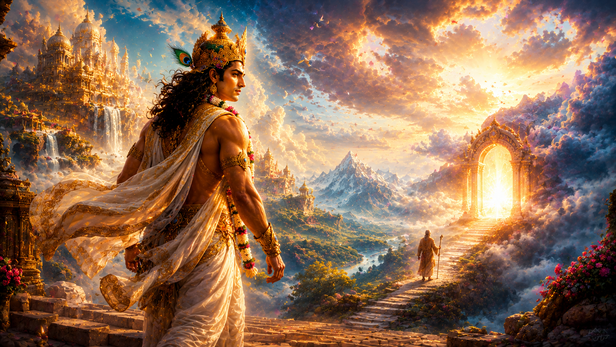
Indra Leaving Heaven in Search of the True Self
Indra ruled the heavens with unmatched strength and authority, yet one question disturbed his heart: Who am I beyond power and titles? Instead of ignoring this doubt, he sought the guidance of Sage Prajapati. His decision reminds us that external success cannot answer life's deepest questions. Wealth, recognition, and achievements may define our role in the world, but they cannot reveal our true identity. Real wisdom begins the moment we become willing to question everything we think we know about ourselves.
The Reflection That Looked Real but Wasn't

Indra Looking Into a Still Pool of Water
Prajapati first pointed Indra toward his reflection, suggesting that the Self could be what he saw. At first, the answer seemed convincing. But as Indra reflected more deeply, he realized that the body changes with age, illness, and time. If the body constantly changes, how could it be eternal? He returned to his teacher, understanding that appearances cannot define the Self. This first lesson teaches that what is temporary cannot be the foundation of lasting identity.
Why Dreams Could Not Reveal the Truth
Beyond Silence Lies Pure Awareness
The Discovery That Changed Indra Forever
The Ego Delays What the Heart Already Knows
What Indra's Journey Means for Us Today
Unlock insightful tips and inspiration on personal growth, productivity, and well-being. Stay motivated and updated with the latest at My Life XP.
Frequently Asked Questions (FAQs)
The story comes from the Chandogya Upanishad, where Indra, the king of the gods, seeks the true nature of the Self (Atman) under the guidance of Sage Prajapati. Through years of learning and reflection, he realizes that the Self is not the body, the mind, dreams, or deep sleep, but the unchanging awareness behind all experiences.
2. Why did Indra take 100 years to understand the truth?
According to the Upanishad, Indra's spiritual training unfolded over a long period because each stage required deep contemplation and self-realization. The "100 years" symbolizes patience, discipline, and the gradual removal of false beliefs rather than simply the passage of time.
3. What is the main teaching of the Chandogya Upanishad in this story?
The central teaching is that our true identity is Atman—the eternal, unchanging consciousness that witnesses every experience. The body, thoughts, emotions, dreams, and even deep sleep are temporary, while the Self remains constant.
4. Who was Sage Prajapati, and why did Indra learn from him?
Prajapati is revered in the Upanishads as a great spiritual teacher who imparts the knowledge of the Self. Indra approached him because he wanted to understand the ultimate truth beyond worldly power, success, and even divine status.