The first thing most visitors notice about Ha Long Bay is that the towers seem too vertical, too isolated, too improbable for a natural landscape. They rise straight from the water with almost no foothills, no gradual slope, no transition between the sea and the rock. That abruptness is not an illusion. It is the direct result of a geological process that spent roughly 500 million years carving the stone before the ocean was even part of the story.
The Rock Came First, and It Was Never Meant to Be Here
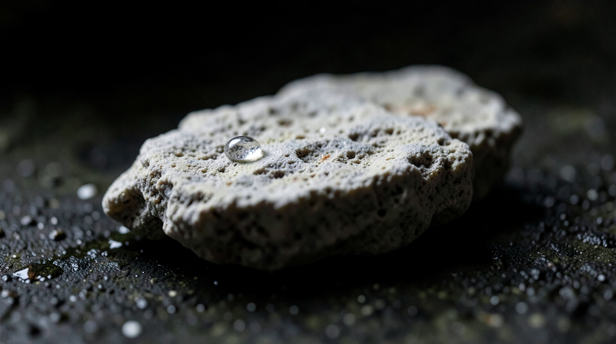
![Limestone Drop Detail]()
Limestone Drop Detail
Image credit : MyLifeXP Bureau
The limestone that makes up Ha Long Bay's towers was laid down on the floor of a shallow tropical sea during the Carboniferous and Permian periods, when the region sat near the equator. Over hundreds of millions of years, the shells and skeletons of marine organisms accumulated and compacted into thick beds of calcium carbonate. Tectonic movement eventually pushed those seabed deposits upward, folding and lifting them above sea level and into a broad, flat plateau. At that point, the landscape looked nothing like it does today. There were no towers, no gaps between formations, no open water. There was a limestone plain, exposed to rain.
Rain Did Most of the Work
Limestone dissolves. Not quickly by any human measure, but steadily and without pause. Rainwater absorbs carbon dioxide from the air and the soil and becomes a weak carbonic acid. When that acid meets calcium carbonate, it reacts, slowly eating channels into the rock along its natural joints and fractures. Over millions of years, those channels widen into caves, the caves grow into caverns, and the caverns eventually collapse, leaving behind the depressions, valleys, and eventually the separated towers that define a karst landscape. This process is called karstification, and the limestone plateau that would become Ha Long Bay was subject to it for an extraordinarily long time, through multiple periods of tropical climate when rainfall was heavy and dissolution was fast. The towers are what was left after everything around them was eaten away. They survived because they were slightly denser, slightly less fractured, or simply positioned where the water drained away from them rather than pooling and working at their base.
Then the Sea Rose and Filled the Gaps
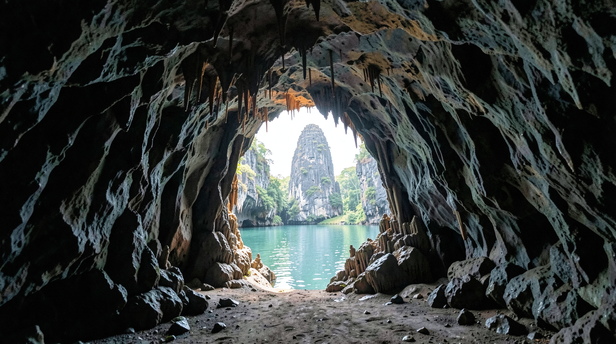
![Tropical Cave Entrance Vista]()
Tropical Cave Entrance Vista
Image credit : MyLifeXP Bureau
The ocean's role in Ha Long Bay is more recent than the karst's, and more passive than it looks. During the last ice age, sea levels across the planet dropped significantly as water was locked into ice sheets. The karst landscape of what is now Ha Long Bay was at that point inland, a terrain of towers and valleys and cave systems sitting well above the coast. As the ice age ended and glaciers melted, sea levels rose globally. The South China Sea crept inland across the low-lying areas of northern Vietnam, filling the valleys between the karst towers with saltwater. The towers did not grow from the sea. The sea grew around them. What looks like a dramatic meeting of rock and ocean is really a flooded plain, with the highest points of the old landscape still protruding above the waterline. The water between the islands is shallow for exactly this reason: it is sitting in valleys, not in open ocean.
Why the Towers Are That Shape
The near-vertical walls of Ha Long Bay's formations are a signature of tropical karst specifically. In temperate climates, limestone landscapes tend to erode more gently, producing rolling hills rather than sheer towers, partly because freeze-thaw cycles attack the rock from multiple angles and partly because vegetation patterns differ. In tropical karst, the dissolution is concentrated at the base of formations, where moisture accumulates and biological acids from dense vegetation add to the chemical attack. This undercutting effect, combined with the way the rock fractures vertically along its natural joints, produces the characteristic straight walls and flat or rounded tops. The towers are not pointed because the top is the last part to erode; they are rounded because the top has been exposed the longest and weathered more evenly, while the base has been actively undercut and then protected by the rising sea.
The Caves Are an Older Chapter
Many of Ha Long Bay's islands are hollow. Hang Sung Sot, Hang Dau Go, and dozens of smaller caverns opened by erosion are the remnants of the drainage systems that once ran through the plateau when it sat above sea level. Water carved these passages over millions of years, moving through the rock the way a river moves through a valley, following the path of least resistance through joints and fractures. When the sea rose, it entered the lower levels of many of these cave systems, sealing them partially and preserving the formations inside. The stalactites and stalagmites in the larger caves formed during the periods when the caves were dry and air-filled, with mineral-rich water dripping slowly from the ceiling over thousands of years. They stopped forming when the sea entered. In some caves, the high-water mark is visible on the walls, a line where the chemistry of the rock changes from marine-stained to dry-weathered.
What the Landscape Is Still Doing
Karstification has not stopped. The towers continue to dissolve at their waterlines, where wave action and chemical erosion work together. The notch visible at the base of many formations, a horizontal groove running around the tower just above the waterline, is active erosion happening now. Over geological time, the towers will continue to shrink, the notches will deepen, and eventually sections will collapse. New cave entrances open when a roof becomes too thin to hold. The landscape that looks permanent and ancient is still in motion, just at a pace that makes a human lifetime feel like a single frame of a very long film.
Ha Long Bay's towers are in the sea because the sea came to them, not because they grew there. The limestone was built, lifted, carved by rain over an immense stretch of time, and then surrounded by rising water at the end of the last ice age. The geology does not make the view less extraordinary. It makes it stranger and more specific: a flooded karst plateau, its highest points still standing, its valleys now navigated by boats rather than rivers.
.