Majuli sits in the middle of the Brahmaputra in Assam, surrounded by one of the widest and most restless river systems on earth. It is not a stable island that a river happens to pass around. It is a temporary arrangement of sand and silt that the river assembled over centuries and has been renegotiating ever since. Every flood season, the Brahmaputra does not simply rise and recede, it shifts, cuts, and takes. The island that remains is smaller than the one that was there before.
The Brahmaputra Is a Braided River, and That Changes Everything
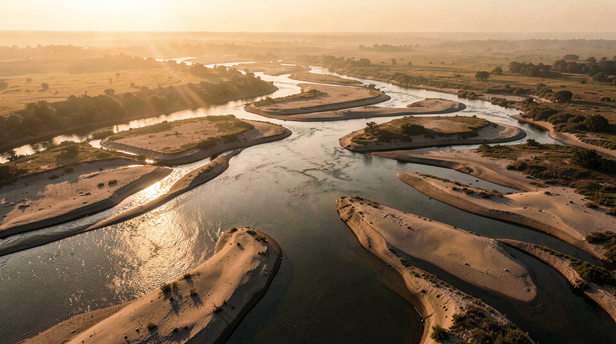
![Braided River at Golden Hour]()
Braided River at Golden Hour
Image credit : MyLifeXP Bureau
Most rivers have a single channel. The Brahmaputra does not. It is what geographers call a braided river, it splits into dozens of channels that weave around each other, merge, separate again, and change course after every major flood. The channels are not fixed. A channel that runs along the northern edge of Majuli one year may swing south the next, eating into land that was dry and farmed.
Braiding happens because the Brahmaputra carries an enormous load of sediment, sand, gravel, and fine silt washed down from the eastern Himalayas and the hills of Arunachal Pradesh. When the river slows, it cannot carry all of it, so it drops the sediment and splits around the pile. The result is a river that is extraordinarily wide and extraordinarily shallow in places, with no stable bank anywhere along its length. Majuli formed in this system and is subject to the same logic as every sandbar in it.
Why Floods Here Erode Rather Than Just Inundate
A flood on a single-channel river typically rises, covers low ground, and falls. The damage is from water pressure and deposit. On a braided river like the Brahmaputra, the flood also redirects channels. When the monsoon swells the river to several times its dry-season volume, the water finds new paths across the floodplain. Some of those paths cross land that was Majuli's edge.
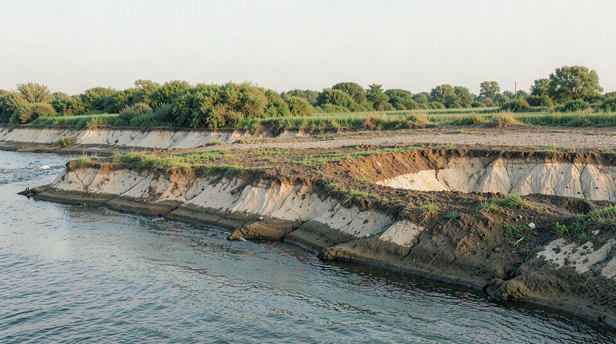
The erosion is not only from the top, water sitting on land and softening it. It is lateral. The moving water cuts sideways into the island's banks, undercutting the soil from below until sections collapse into the current. This bank erosion is faster and harder to reverse than surface flooding. A field that floods can be replanted. A bank that has fallen into the river is gone.
The monsoon also brings the highest sediment load of the year down from the hills. The river drops much of that sediment on its bed, raising it, which forces the water to spread wider. The island's margins are where that spreading happens first.
The Geology Underneath Offers No Resistance
![Riverbank's Gentle Erosion]()
Riverbank's Gentle Erosion
Image credit : MyLifeXP Bureau
Majuli is built on alluvial material, the same sediment the river deposited to create it. There is no rock, no consolidated clay, no hard substrate to anchor the banks. The island is, in geological terms, young and loose. When a river channel presses against an alluvial bank, the bank has no structural argument to make. It goes.
This is different from river islands elsewhere that sit on bedrock or older, compacted earth. Those islands lose their edges slowly, if at all. Majuli's edges are made of the same material the river is already carrying downstream. The transition from island to riverbed is a matter of energy, not resistance.
The fine silt that makes Majuli's soil so fertile for cultivation is also the reason it cannot hold its shape against a moving channel. The two facts are inseparable.
What Has Made the Loss Faster in Recent Decades
The Brahmaputra has always taken from Majuli. Historical accounts from the eighteenth and nineteenth centuries describe an island considerably larger than the one that exists now. But the rate of loss accelerated through the twentieth century, and the reasons are not mysterious.
Deforestation in the catchment areas upstream, the hills of Arunachal Pradesh and the slopes feeding the Brahmaputra's tributaries, increased the volume of sediment entering the river. More sediment means a more aggressively braiding river, with more frequent channel shifts. The embankments built along parts of the Brahmaputra to protect farmland elsewhere altered the river's behaviour in ways that concentrated erosive force in unprotected stretches, including around Majuli.
Earthquakes have also played a role. The 1950 Assam earthquake, one of the largest recorded in the region, dramatically raised the riverbed in places by shaking loose enormous quantities of hillside material. A higher riverbed means a shallower river that spreads more widely, and a river that spreads more widely takes more of its floodplain with it.
The Island That Remains Is Still Inhabited and Still Significant
Majuli is home to the Mishing, Deori, and other communities who have adapted their architecture, their agriculture, and their movement patterns to the river's behaviour for generations. The satras, Vaishnavite monasteries that have been centres of Assamese art, mask-making, and devotional practice for five centuries, have relocated as the island's edges changed. Some have moved more than once.
The knowledge of how to read the river, when to move, and what to build on ground that will not last is as much a part of life on Majuli as the farming calendar. That knowledge is not resignation. It is a practical understanding of what the Brahmaputra is: not a boundary, but a process.
The island is smaller than it was, and it will be smaller again. What makes Majuli worth understanding is not the loss alone, but what it reveals about the nature of a river that has never agreed to stay in one place, and the people who have built something lasting on ground that was always temporary.
Unlock insightful tips and inspiration on personal growth, productivity, and well-being. Stay motivated and updated with the latest at
My Life XP.