Hair looks like a single smooth surface from a distance, but under a lens it resembles a stack of roof tiles laid over a long cylinder. Those tiles are the cuticle, overlapping, translucent scales of keratin that lie flat when hair is healthy and lift when something chemical or physical disturbs them. Bleach disturbs them deliberately, because that is how it gets to the colour underneath. What follows is a chain of events that changes the strand in ways that last until that section of hair is cut away.
The Cuticle Opens Before Anything Else Happens
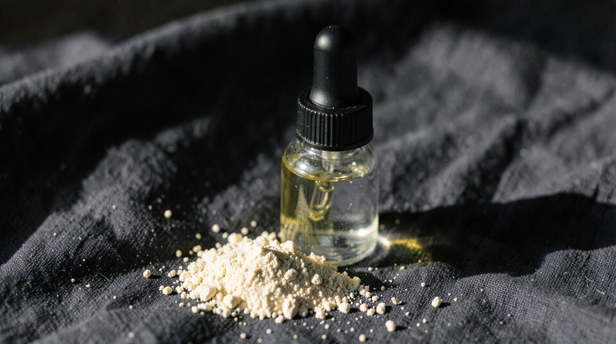
![Botanical Oil and Powder Study]()
Botanical Oil and Powder Study
Image credit : AI
Bleach is an alkaline mixture. The moment it contacts the hair shaft, the high pH signals the cuticle scales to swell and separate, the same way a pine cone opens in warm air. This is not damage, it is the intended first step. The cortex, the dense inner layer that holds your hair's pigment, is sealed behind those scales. Without lifting them, the active ingredient in bleach, hydrogen peroxide, cannot reach it. The alkaline agent in most bleach powders and creams is ammonium persulfate or a similar persulfate salt, and it is doing this opening work while the peroxide waits to do the next part.
Inside the Cortex: What Happens to the Colour Molecules
Once the cuticle is lifted, hydrogen peroxide enters the cortex and begins oxidising melanin, the pigment that gives hair its colour. Melanin comes in two forms: eumelanin, which produces brown and black tones, and pheomelanin, which produces red and yellow tones. Peroxide breaks the chemical bonds that hold melanin molecules together, converting them into smaller, colourless compounds. Eumelanin oxidises faster and more completely than pheomelanin, which is why hair going through a single bleach session often passes through orange and gold before reaching pale yellow, the pheomelanin is the last to go, and it resists. The warmth in the developer accelerates the reaction, which is why bleach applied to already-warm scalp roots lifts faster than bleach applied to the cooler mid-lengths.
What the Peroxide Breaks Besides Pigment
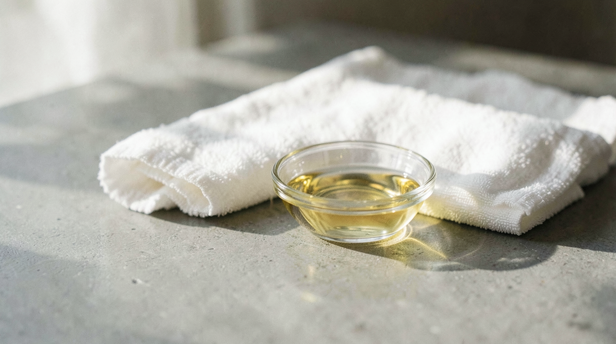
![Golden Oil and Towel]()
Golden Oil and Towel
Image credit : AI
Peroxide does not distinguish between melanin bonds and the bonds holding the hair's structural proteins together. While it is dismantling pigment, it is also oxidising cysteine, the amino acid responsible for the disulfide bonds that give keratin its strength and elasticity. Those disulfide bonds are the reason healthy hair stretches slightly and returns to shape. When they are broken, the cortex becomes porous and the strand loses its ability to hold moisture or resist mechanical stress. This is the structural cost of lightening, and it accumulates with each session. A strand that has been bleached three times has lost significantly more of its disulfide integrity than one bleached once, even if both look similarly pale.
Why the Cuticle Does Not Simply Close Again
After bleach is rinsed away and an acidic conditioner brings the pH back down, the cuticle scales do partially return toward their resting position. The word to hold onto is partially. Scales that have been repeatedly swollen and contracted become rougher at their edges and lie less flat than they did before. This is why bleached hair feels coarser to the touch, catches light differently, and tangles more easily, the surface is physically altered. The gaps between scales also allow moisture to move in and out of the cortex more freely than it should, which is why bleached hair can feel dry even immediately after washing and can absorb water so quickly that it becomes fragile when wet. Wet bleached hair is at its most vulnerable because water temporarily weakens the remaining hydrogen bonds holding the strand together.
What Actually Helps, and What Does Not
Protein treatments work by temporarily filling the gaps in a compromised cuticle with hydrolysed protein molecules small enough to enter the cortex. They do not rebuild disulfide bonds, but they reduce porosity and restore some of the strand's ability to hold moisture. Bond-building treatments, a category that includes ingredients such as maleic acid and bis-aminopropyl diglycol dimaleate, work differently, they form new bonds within the cortex that partially compensate for the disulfide bonds broken during bleaching. The evidence for bond-builders is stronger than for protein alone, and the two are not interchangeable. Deep conditioning with humectants and emollients addresses surface feel and moisture retention but does not touch the structural interior. All of these are maintenance tools, not repairs. The cortex altered by bleach does not regenerate. Managing bleached hair well means managing porosity, minimising mechanical stress, and understanding that the strand you are working with is chemically different from the one you started with.
Unlock insightful tips and inspiration on personal growth, productivity, and well-being. Stay motivated and updated with the latest at
My Life XP.