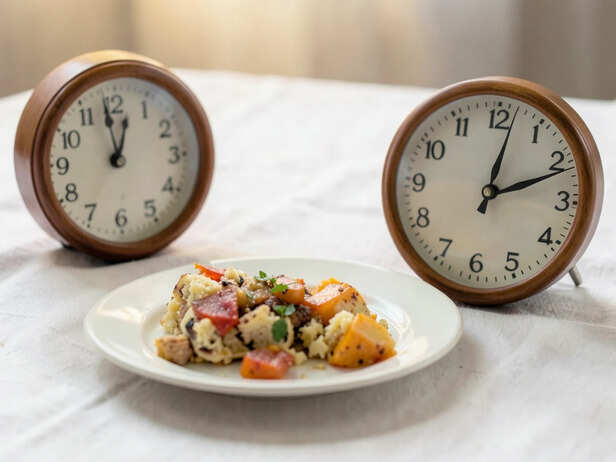
There is a particular kind of evening frustration that most parents recognise: the child who ate half a packet of biscuits at five o'clock and then sat at the dinner table at eight, moving food around the plate without interest. The parent who cooked the dinner feels the sting of it. The child is not being difficult. She is simply not hungry, and she is not hungry for a reason that has nothing to do with manners or gratitude.
Children's stomachs empty faster than adults' do. A child who ate a meaningful snack two to three hours before dinner has, by the time dinner arrives, neither fully digested it nor fully emptied out. She is sitting somewhere in the middle, not hungry, not full, and entirely uninterested in a plate of food she did not ask for. The dinner refusal is not the problem. The snack timing is.
How a Child's Hunger Cycle Actually Works
![Empty Bowl, Waiting Spoon]()
Empty Bowl, Waiting Spoon
Image credit : MyLifeXP Bureau
A young child's stomach is roughly the size of her fist. It empties in about two to three hours, which is why children genuinely need to eat more frequently than adults. This is not a preference or a phase. It is physiology. The hunger cycle that results is short and fairly predictable: a child who eats lunch at one o'clock will be genuinely hungry again by three or three-thirty. By five, that hunger has peaked and passed its most intense point. By eight, she has either eaten something to address it or she has moved through it and is no longer interested in food at all.
When the snack at five is large enough, calorie-dense enough, or simply satisfying enough to blunt that hunger, the body registers it as a meal. The brain stops sending hunger signals. Dinner, arriving three hours later, finds a child whose body has already received what it needed. The plate of rice and dal is not appealing because it is not needed.
What the Afternoon Snack Is Actually Doing
The snack at five is often not planned as a meal. It is handed over because the child is asking, because the parent is busy, because the biscuit packet is within reach. The child eats more than intended because she is genuinely hungry at that hour, the hunger from lunch has built over the afternoon and she is ready to eat. Biscuits, chips, and crackers are designed to be easy to keep eating. They are light in texture, fast to chew, and engineered to delay the sensation of fullness. A child can eat two hundred calories of biscuits without feeling full in the way she would feel full after two hundred calories of rice and curd.
This is not a reason to ban the snack. It is a reason to think about what the snack is and how much of it is available at once. A bowl of something rather than an open packet gives the child a boundary she can see. A snack that includes some protein, a small bowl of curd, a handful of roasted chana, a piece of paneer, satisfies the hunger more completely and holds her longer. She arrives at dinner genuinely ready for it.
The Timing Adjustment That Changes the Evening
![Untouched Dinner at Eight]()
Untouched Dinner at Eight
Image credit : MyLifeXP Bureau
Moving the snack earlier by thirty to forty-five minutes is often enough to shift the whole pattern. A child who eats at four-thirty instead of five has more time to digest before an eight o'clock dinner. A child who eats at four has even more. The snack does not need to disappear. It needs to stop landing in the window that belongs to dinner's appetite.
Dinner timing matters too. Many Indian families eat late, with dinner at eight or eight-thirty as a household norm built around adult schedules. A child whose natural hunger cycle peaks at six or six-thirty has already moved through that peak by the time the family sits down. Offering a small, early dinner for the child, even if the adults eat later, is one way to meet the cycle where it is rather than where the schedule prefers it to be.
When the Refusal Is About Something Else
Not every dinner refusal is about snack timing. A child who is tired, overstimulated, or anxious will often refuse food even when she has not snacked heavily. The dinner table can carry the weight of a long day in a way that makes eating feel like one more demand. A child who has been at school, at tuition, and in front of homework for several hours may need ten minutes of quiet before she can settle into a meal. Sitting her down the moment she is called and expecting appetite is sometimes asking for more than she has left to give.
There is also texture, temperature, and the particular stubbornness of a child who has decided that tonight's vegetable is not one she is eating. These are separate from the hunger question and need separate handling. The snack-timing fix addresses the physiological piece. The rest is the longer, slower work of the table.
What to Do With the Biscuit Packet
The biscuit packet does not need to go. What changes is when it appears, how much comes out at once, and what it is paired with. A small portion of something sweet or crunchy alongside something that actually satisfies hunger, fruit, a boiled egg, a small bowl of sprouts, gives the child the snack she wants and the nutrition that will hold her until dinner. The open packet on the kitchen counter, available until she stops reaching into it, is the version that quietly fills the space dinner was meant to occupy.
Hunger in children is not a character trait. A child who snacks heavily and refuses dinner is not being wilful. She is eating when she is hungry and not eating when she is not. The job is to arrange the day so that hunger and meals arrive at the same time.
Unlock insightful tips and inspiration on personal growth, productivity, and well-being. Stay motivated and updated with the latest at
My Life XP.