A Nataraja stands in more museums, temples, and living rooms across India than almost any other sacred image. Most people who own one or pass one daily could not say what the ring of fire surrounding Shiva means, or why one foot is raised, or what the dwarf beneath his foot has to do with liberation. The image is not decorative. It is a complete philosophical argument, compressed into bronze, and every element of it is load-bearing.
The Ring of Fire Is Not a Frame
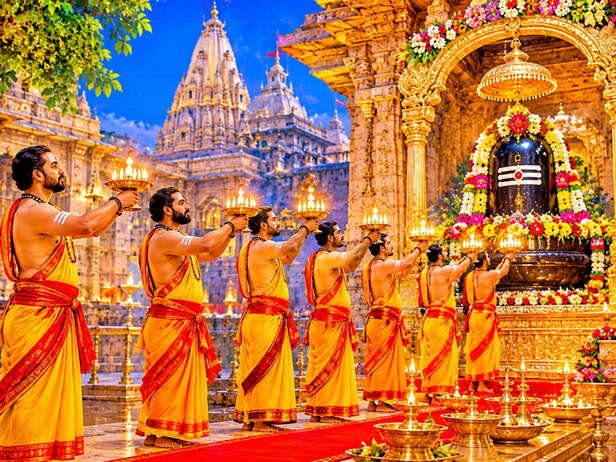
![Seven Priests Performing Aarti at Shiva Shrine]()
Seven Priests Performing Aarti at Shiva Shrine
Image credit : chatgpt(ai)
The outer circle that surrounds Shiva in the Nataraja is called the prabhamandala, the halo of glory, and in this form it is specifically a ring of flame. In the Shaiva tradition, this fire is not background decoration. It represents the continuous process of creation and dissolution that the tradition holds to be the nature of the universe. The flames are not burning the dance; they are the dance. Everything that exists, in this reading, is fire in different stages of transformation, matter arising, taking form, and returning to energy. The ring is the universe itself, and Shiva dances at its centre, not outside it.
The Four Hands Each Carry One Idea
The Nataraja's four arms are not a display of power. Each hand holds or signals one specific thing, and together they describe a complete cycle. The upper right hand holds a small hourglass drum called the damaru. In Shaiva thought, the first sound the universe made was the sound of that drum, the vibration from which matter and language arose. The Mahabhasya, the ancient Sanskrit grammar text, opens with a reference to Shiva's drum as the origin of the sounds of speech. The upper left hand holds a tongue of fire. Creation in one hand, dissolution in the other: the tradition places both in the same figure to say they are not opposites but partners. The lower right hand is raised in the abhaya mudra, the gesture of protection, with the palm facing outward. The lower left hand points downward toward the raised foot, which is the gesture called gaja hasta, the elephant trunk, directing attention to where liberation is said to be found.
The Dwarf Underfoot Is Not a Defeated Enemy
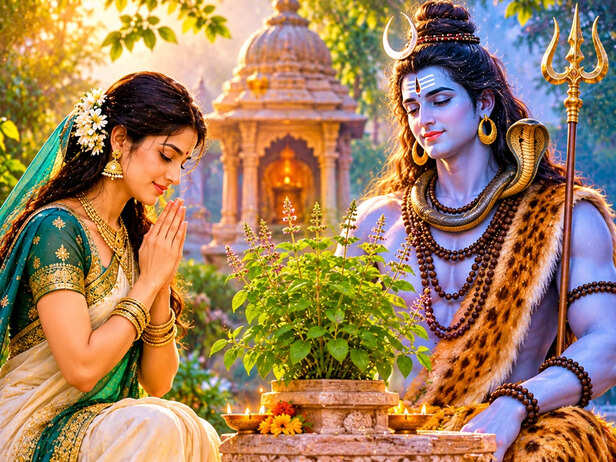
![Tulsi Devotion with Lord Shiva]()
Tulsi Devotion with Lord Shiva
Image credit : chatgpt(ai)
Beneath Shiva's planted foot lies a small figure called Apasmara, sometimes translated as the demon of forgetfulness or of heedlessness. In Shaiva philosophy, Apasmara represents the ignorance that causes a person to mistake the temporary for the permanent, to forget that the self is not the body, the role, or the accumulation of experience. Shiva does not kill Apasmara. The tradition is precise on this point: Apasmara must not die, because if ignorance were destroyed entirely, the possibility of forgetting would cease, and with it the possibility of seeking. The dance continues because the forgetting continues. The foot holds Apasmara down without ending him, which is a different kind of statement about the relationship between awareness and the ordinary human tendency to lose it.
Why the Foot Is Raised
The raised left foot is the image's most discussed gesture. In the Agamic texts of the Shaiva Siddhanta tradition, which gave the Nataraja its canonical form in Tamil Nadu roughly between the seventh and tenth centuries, the raised foot is the point toward which the lower left hand directs the devotee's gaze. It represents moksha, release from the cycle described by everything else in the image. The foot is not mid-step. It is held. The dance is not going anywhere. It is the stillness inside motion, which is the tradition's way of describing what liberation feels like from inside ordinary life: not an escape from the world but a different relationship to it.
Where the Bronze Form Came From
The Nataraja as a bronze image reached its fullest form under the Chola dynasty in Tamil Nadu, roughly between the ninth and thirteenth centuries. Chola bronze-casters worked in the lost-wax method called cire perdue, in which a wax model is built, coated in clay, fired to melt the wax out, and then filled with molten metal. Each Nataraja cast this way is unique because the wax original is destroyed in the process. The Chola Nataraja bronzes held in the Government Museum in Chennai and in the collection of the Thanjavur Art Gallery are among the most studied examples of this form. The image had existed in stone carving before the Chola period, there are Nataraja carvings in the cave temples at Badami in Karnataka that predate the Chola bronzes, but it was the Chola form, with its specific proportions and its complete iconographic programme, that became the canonical version recognised across the world.
The Five Acts the Dance Describes
In the Shaiva Siddhanta reading that shaped the Chola iconography, the Nataraja's dance is called the ananda tandava, the dance of bliss, and it enacts five acts simultaneously. These five acts are creation, sustenance, dissolution, concealment, and grace. The drum creates. The fire dissolves. The raised hand sustains and protects. The foot on Apasmara conceals, in the sense that ordinary life, held down but not ended, is what keeps the self inside the world long enough to seek. The raised foot is the fifth act: grace, the moment of release that the tradition holds to be available at any point in the cycle, not only at its end. The image does not show a sequence. It shows all five happening at once, which is the point: the tradition holds that these five acts are not events in time but the permanent condition of existence, always simultaneously in motion.
The Nataraja is sometimes described as a symbol of cosmic energy, which is accurate but incomplete. It is more precisely a diagram of a philosophical position: that the universe is not moving toward resolution, that ignorance is not an enemy to be defeated but a condition to be seen clearly, and that the stillness the tradition calls liberation is not somewhere outside the fire but at its centre, held in a raised foot that goes nowhere. The bronze says all of this without a word, which is why the tradition chose bronze.
Unlock insightful tips and inspiration on personal growth, productivity, and well-being. Stay motivated and updated with the latest at
My Life XP.