The list most people learn, Matsya, Kurma, Varaha, Narasimha, Vamana, Parashurama, Rama, Krishna, Balarama or Buddha, and Kalki, feels, at first glance, like a chronicle of separate rescues. A fish saves the Vedas. A tortoise steadies a mountain. A boar lifts the earth. Each story stands alone, with its own villain and its own crisis. What the Puranas are doing, though, is not cataloguing emergencies. They are building a sequence, and the sequence carries a meaning that the individual stories only hint at.
The First Four Move from Water to Land
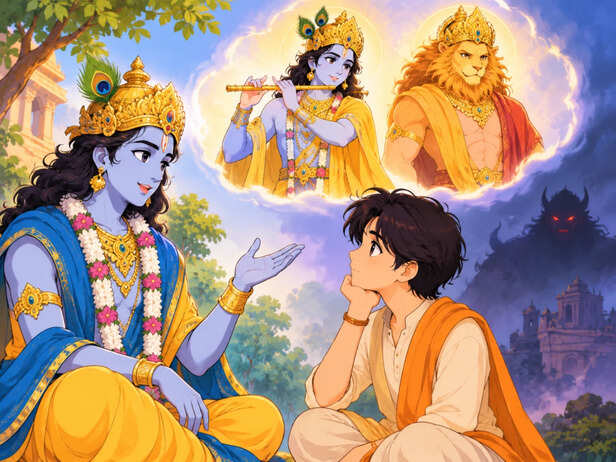
![Vishnu’s Divine Teachings and Avatars]()
Vishnu’s Divine Teachings and Avatars
Image credit : chatgpt(ai)
Matsya is a fish. Kurma is a tortoise, an animal equally at home in water and on land. Varaha is a boar, a creature of the earth. Narasimha is half lion, half man, not quite animal, not quite human. The Puranas open with water and move steadily toward the terrestrial, the upright, the recognisably human. This is not incidental. In Puranic cosmology, creation itself proceeds from the primordial ocean. The sequence begins where existence begins: submerged, formless, aquatic. Each avatar steps further onto dry ground.
The Middle Avatars Refine What Human Means
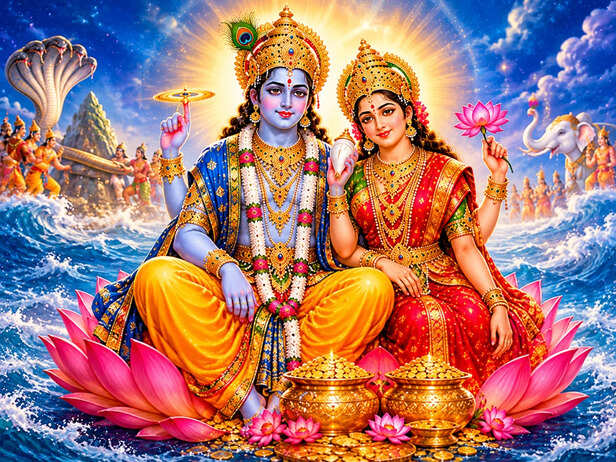
![Vishnu and Lakshmi on the Lotus]()
Vishnu and Lakshmi on the Lotus
Image credit : chatgpt(ai)
Vamana is a dwarf, fully human in form but not yet in full power, a brahmin boy who contains the universe and reveals it only when pushed. Parashurama is a man of complete physical force, a warrior brahmin whose anger is his defining quality. Rama is a king who chooses dharma over desire at every turn, whose story the Ramayana reads as the cost of that choice. Krishna contains all of these: the child, the lover, the strategist, the teacher. The movement from Vamana to Krishna is a movement from constrained power to its fullest expression. Each avatar in this band is recognisably a person, but each one holds a different idea of what a person can be.
Why the Ninth Position Has Always Been Contested
In the Bhagavata Purana, the ninth avatar is listed as Buddha. In several other Puranic traditions, it is Balarama, Krishna's elder brother. The disagreement is old and genuinely unresolved, different texts make different choices, and regional traditions have followed their preferred list for centuries. Where Buddha appears, the Puranic explanation is usually that Vishnu took this form to lead the unrighteous away from the Vedas by teaching a path that would eventually return them to dharma by a longer road. Where Balarama appears, the emphasis falls on the pair: Krishna and Balarama as inseparable, the dark and the fair, the strategist and the ploughman. Neither version is wrong within its own textual tradition. A reader who has only ever seen one list should know the other exists.
Kalki Has Not Come Yet, and That Is the Point
The tenth avatar is the only one described entirely in the future tense. Kalki will arrive on a white horse at the end of the current age, the Kali Yuga, to end a cycle that has grown too corrupt to continue. The Puranas are precise about what he will do and deliberately vague about when. No tithi, no year, no sign that a reader could watch for. The sequence closes on an open door. This is not an oversight. The Dashavatara is a cycle, not a line. After Kalki, the Puranas say, a new Satya Yuga begins and the sequence starts again. The tenth avatar's incompleteness is structural, the list cannot close because the cycle does not.
What the Sequence Has Been Read to Mean
From at least the medieval period, commentators within the Vaishnava tradition have read the Dashavatara as a description of progressive cosmic order: the divine descending into increasingly complex forms as creation itself grows more intricate. Some later thinkers, notably in the nineteenth and twentieth centuries, drew a comparison to biological evolution, fish to amphibian to land animal to human, and found the parallel striking. That comparison is interesting as a cultural observation, but it belongs to a later interpretive layer, not to the Puranas themselves. The Puranas are not doing natural history. They are describing how dharma requires different forms in different ages, and how the divine meets each age in the form that age can receive.
The order the Puranas give is not the order in which scholars believe the avatar stories developed historically, Rama and Krishna are almost certainly older in the popular tradition than Matsya or Kurma. The sequence is theological, not chronological. It describes a logic of descent: from the simplest possible form of life to the most complex, from the purely physical to the fully conscious, from the present to the not-yet. That logic is why the list has stayed in the order it has, across texts, regions, and centuries of retelling.
Unlock insightful tips and inspiration on personal growth, productivity, and well-being. Stay motivated and updated with the latest at
My Life XP.