Arjuna's collapse at Kurukshetra is one of the most precisely described moments in the Mahabharata. He asks Krishna to drive the chariot between the two armies, looks at the faces on both sides, and his bow falls from his hands. The Gita begins not with a question about the nature of the soul or the path to liberation, but with a man unable to stand up. That starting point is the whole argument for the battlefield.
A Hermitage Produces a Different Kind of Seeker
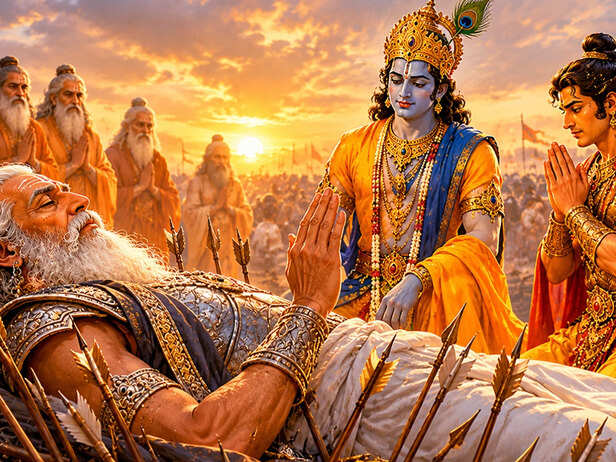
![Bhishma Pitamah's Final Wish: The Five Days of Devotion Before His Departure]()
Bhishma Pitamah's Final Wish: The Five Days of Devotion Before His Departure
Image credit : CHATGPT(AI)
A forest hermitage, in the tradition that produced the Upanishads, is where a person goes after the world has already released them. The student who sits with a guru in the forest has, by the act of going there, already made a choice: I am ready to leave ordinary life behind. The teaching that follows is addressed to that person. It assumes a certain detachment has already been achieved, or at least sincerely sought.
Arjuna had made no such choice. He was a warrior, a husband, a son, a prince with debts and duties and people he loved on both sides of the field. The Gita's tradition holds that this is not a flaw in the setting. It is the point. The teaching was always meant for someone still inside their life, not someone who had arranged to leave it.
The Crisis Is What Makes the Question Real
In Vedantic thought, real inquiry begins with what is sometimes called viveka, the capacity to distinguish between what is permanent and what is not. That capacity rarely arrives on a calm afternoon. It tends to arrive when something a person believed was solid turns out not to be.
Arjuna believed that winning the war was the obvious right thing to do. He believed that his role as a warrior was clear. He believed he understood his duties and his loves. All of that collapsed in the space of a few minutes on the field. His grief, which the Gita describes in considerable physical detail, is the moment his old framework for understanding the world stopped working.
The tradition reads this not as weakness but as readiness. The Sanskrit term used in some commentaries is adhikara, roughly the qualification or ripeness to receive a teaching. Arjuna's grief was his qualification. A man who had walked onto that field confident and unmoved would not have been ready to hear what Krishna was about to say. The battlefield produced the question that the hermitage could not have manufactured.
Krishna Comes to Where the Crisis Is
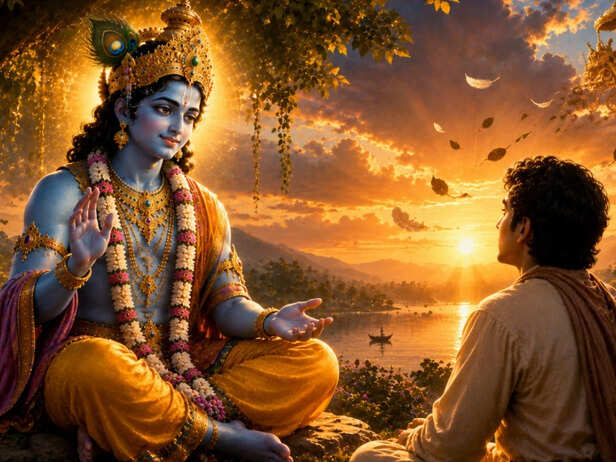
![Krishna and Arjuna on the Battlefield]()
Krishna and Arjuna on the Battlefield
There is something in the structure of the Gita that commentators across traditions have noted: Krishna does not summon Arjuna to a sacred place and then teach him. He is already there, already the charioteer, already inside the situation. The divine, in this telling, does not wait at a distance for the seeker to arrive purified and prepared. It is present in the middle of the ordinary catastrophe.
This is one of the reasons the Gita has been read not only as a text for renunciants but as a text for anyone in the middle of an impossible situation. A hermitage teaching addresses someone who has stepped out of the world. The battlefield teaching addresses someone who cannot step out, who has responsibilities they cannot abandon and relationships they cannot dissolve, and who still needs to know how to act rightly.
Dharma Only Becomes a Problem When It Conflicts With Itself
The central question Arjuna brings to Krishna is not abstract. It is: what should I do right now, when every option causes harm to someone I am bound to protect? His duty as a warrior says fight. His love for his teachers and cousins says do not. Neither duty is false. They have simply collided.
This kind of conflict cannot be staged in a hermitage. In a forest, the student has already resolved the competing claims of the world by leaving them. The question of what to do when dharma pulls in two directions at once only becomes urgent when you are standing where the two directions meet. The battlefield is the only setting where that question is real rather than theoretical.
The tradition holds that this is why the Gita's teaching on action, on nishkama karma, on doing what must be done without attachment to the outcome, had to be given in that moment and not in a calmer one. A teaching about acting without grasping at results is most honest when it is given to someone who is about to act and is terrified of the results.
The Battlefield as the World Itself
Later commentators, including Adi Shankaracharya and in a very different register Bal Gangadhar Tilak, read Kurukshetra as something larger than a historical site. In this reading, the battlefield stands for the field of ordinary human life: full of competing obligations, irreversible choices, people you love on opposing sides, and no clean exit. Every person who has faced a decision with no good answer is, in some sense, standing where Arjuna stood.
The hermitage, in this reading, is not wrong. It is a different path, suited to a different seeker at a different moment. But the Gita was not written for that seeker. It was written for the one who cannot leave, who must act, who is already in the middle of something that will not wait. The opening on the battlefield was not a dramatic choice. It was a precise one.
The grief that drops Arjuna's bow is the same grief that makes the teaching necessary. Strip away the setting and you strip away the reason anyone needed to speak at all.
Unlock insightful tips and inspiration on personal growth, productivity, and well-being. Stay motivated and updated with the latest at
My Life XP.