What Did Lanka Realize About Hanuman That Ravana Never Did?
Noopur Kumari | Jun 21, 2026, 08:00 IST
Sundarkand presents one of the most powerful moments in the Ramayana. As Hanuman burns Lanka, the citizens realize he is no ordinary monkey. They recognize a divine force at work. Yet despite witnessing this warning, Ravana refuses to surrender his ego. The destruction of Lanka becomes a timeless lesson about pride, wisdom, and the consequences of ignoring truth when it stands right before us.

What destroys a kingdom first? Is it a powerful enemy? A devastating war? Or a ruler who refuses to listen? The story of Lanka's destruction reveals a surprising truth. Long before Lord Rama's army arrived at its gates, Lanka had already begun to fall. The warning signs were everywhere. Wise advisors spoke. Loyal servants cautioned. Even ordinary citizens sensed something was wrong.
Yet Ravana ignored them all. And when Hanuman set Lanka ablaze, it was not merely a city burning it was the visible consequence of years of arrogance, pride, and refusal to accept the truth.
![The Fire That Spoke]()
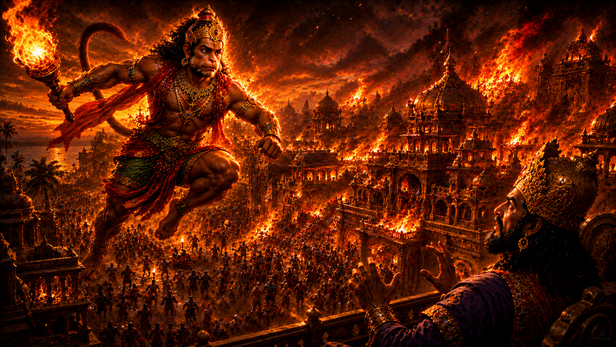
When Hanuman's tail was set on fire, Ravana believed he was humiliating a messenger. Instead, he unknowingly created the very force that would expose Lanka's weakness. As Hanuman leaped from palace to palace, flames spread across the golden city. The fire was more than destruction. It was a message. Every burning building reflected the consequences of Ravana's choices. The city was not being punished without reason. It was witnessing the result of a ruler who repeatedly ignored dharma, wisdom, and opportunities to change.
![The Citizens' Realization]()
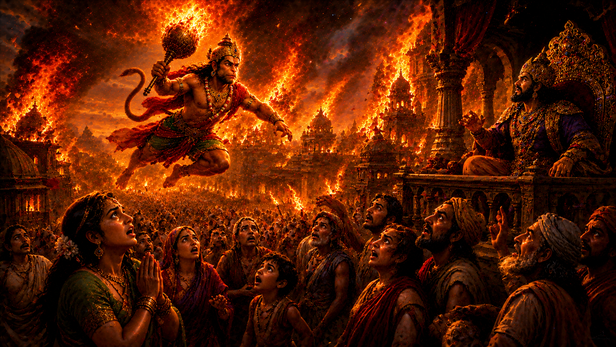
As the fire spread, cries echoed throughout the city. Families searched for safety while panic consumed the streets. During this chaos, many citizens reached a startling conclusion. They openly admitted that Hanuman could not be an ordinary monkey. They believed he was a divine being disguised in vanara form. The people recognized the extraordinary nature of the event. Ironically, those with the least power understood the truth first, while the most powerful man in Lanka remained blind to it.
The Sundarkand describes how the forty-nine winds began to blow by divine will. These winds intensified the flames and carried them throughout Lanka. This detail reveals something important. Hanuman was not acting out of personal anger or revenge. He was carrying out a divine mission. His actions became an instrument of cosmic justice. The destruction was not random. It was part of a larger process meant to awaken Lanka to the consequences of adharma and offer one final warning before greater events unfolded.
One of the most overlooked aspects of the story is that Lanka's destruction was not the end. Ravana still had opportunities to correct his mistakes. He could have returned Sita. He could have listened to Vibhishana. He could have sought peace. The burning of Lanka was not a final punishment. It was a warning. The tragedy lies in the fact that Ravana saw the evidence but refused to accept its meaning. His ego transformed a warning into a catastrophe.
Ravana was intelligent, learned, and powerful. Yet none of these qualities could save him from his greatest weakness—ego. Pride convinced him that he could not be wrong. It made him dismiss good advice and underestimate his opponents. This is why ego is so dangerous. It does not remove intelligence. It blinds intelligence. Ravana's downfall was not caused by a lack of knowledge. It was caused by his refusal to accept knowledge that challenged his beliefs.
The citizens of Lanka witnessed events with open eyes. They were not distracted by power, status, or ambition. As a result, they recognized the divine significance of Hanuman's actions. Their reaction teaches an important lesson. Sometimes ordinary people understand reality more clearly than leaders consumed by pride. Wisdom is not determined by position. It is determined by the willingness to see the truth, even when that truth is uncomfortable.
Lanka's story continues to resonate because it reflects a universal human struggle. People often receive warnings before major problems occur. Relationships show signs of strain. Leaders receive advice. Individuals recognize mistakes. Yet ego convinces them to wait, deny, or ignore. The destruction of Lanka reminds us that consequences rarely arrive without warning. The challenge is whether we recognize the message before it becomes irreversible.
Unlock insightful tips and inspiration on personal growth, productivity, and well-being. Stay motivated and updated with the latest at My Life XP.
1. Why did Hanuman burn Lanka?
Hanuman burned Lanka after Ravana ordered his tail to be set on fire. What was meant to be a punishment became a demonstration of Hanuman's divine power and a warning to Ravana about the consequences of adharma.
2. Did Hanuman burn Lanka out of anger?
Not entirely. According to the Sundarkand, Hanuman's actions were part of a larger divine mission. The burning of Lanka served as a warning and a sign of the power that stood behind Lord Rama's cause.
3. What is the meaning of the verse about the forty-nine winds?
The verse states that the forty-nine winds began blowing by Lord's inspiration. This symbolizes divine support for Hanuman's mission and explains how the fire spread rapidly throughout Lanka.
4. Did the people of Lanka believe Hanuman was an ordinary monkey?
No. As Lanka burned, many citizens openly admitted that Hanuman could not be an ordinary vanara. They believed he was a divine being who had taken the form of a monkey.
5. Why didn't Ravana surrender after seeing Lanka burn?
Ravana's greatest weakness was his pride. Despite witnessing extraordinary events and receiving multiple warnings, his ego prevented him from accepting his mistakes and choosing the path of peace.
Yet Ravana ignored them all. And when Hanuman set Lanka ablaze, it was not merely a city burning it was the visible consequence of years of arrogance, pride, and refusal to accept the truth.
A Warning Hidden in the Flames
The Fire That Spoke
When Hanuman's tail was set on fire, Ravana believed he was humiliating a messenger. Instead, he unknowingly created the very force that would expose Lanka's weakness. As Hanuman leaped from palace to palace, flames spread across the golden city. The fire was more than destruction. It was a message. Every burning building reflected the consequences of Ravana's choices. The city was not being punished without reason. It was witnessing the result of a ruler who repeatedly ignored dharma, wisdom, and opportunities to change.
The Moment Lanka Recognized the Truth
The Citizens' Realization
As the fire spread, cries echoed throughout the city. Families searched for safety while panic consumed the streets. During this chaos, many citizens reached a startling conclusion. They openly admitted that Hanuman could not be an ordinary monkey. They believed he was a divine being disguised in vanara form. The people recognized the extraordinary nature of the event. Ironically, those with the least power understood the truth first, while the most powerful man in Lanka remained blind to it.
Hanuman's Power Was Not His Own
Ravana Still Had a Choice
When Ego Becomes Stronger Than Wisdom
The Citizens Saw What Leaders Missed
The Timeless Lesson of Lanka
Unlock insightful tips and inspiration on personal growth, productivity, and well-being. Stay motivated and updated with the latest at My Life XP.
Frequently Asked Questions (FAQs)
Hanuman burned Lanka after Ravana ordered his tail to be set on fire. What was meant to be a punishment became a demonstration of Hanuman's divine power and a warning to Ravana about the consequences of adharma.
2. Did Hanuman burn Lanka out of anger?
Not entirely. According to the Sundarkand, Hanuman's actions were part of a larger divine mission. The burning of Lanka served as a warning and a sign of the power that stood behind Lord Rama's cause.
3. What is the meaning of the verse about the forty-nine winds?
The verse states that the forty-nine winds began blowing by Lord's inspiration. This symbolizes divine support for Hanuman's mission and explains how the fire spread rapidly throughout Lanka.
4. Did the people of Lanka believe Hanuman was an ordinary monkey?
No. As Lanka burned, many citizens openly admitted that Hanuman could not be an ordinary vanara. They believed he was a divine being who had taken the form of a monkey.
5. Why didn't Ravana surrender after seeing Lanka burn?
Ravana's greatest weakness was his pride. Despite witnessing extraordinary events and receiving multiple warnings, his ego prevented him from accepting his mistakes and choosing the path of peace.