There is a building in the inland delta of the Niger River that has to be remade every year or it will dissolve. The Great Mosque of Djenné is the largest mud-brick structure on earth, and the material that gives it its extraordinary form is also the thing that makes it permanently unfinished. Without intervention, the rains would take it apart wall by wall.
A Building Made of the Ground Beneath It
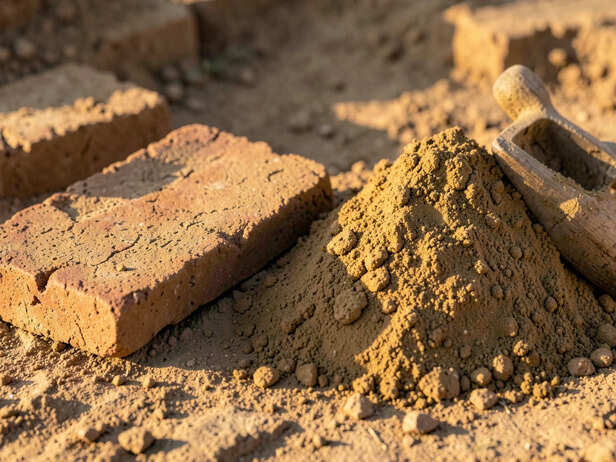
![Mud Brick Construction Materials]()
Mud Brick Construction Materials
Image credit : MyLifeXP Bureau
The mosque is built from banco, a mixture of sun-dried mud, rice husks, and organic binders that has been used across the West African Sahel for at least a thousand years. Banco is not a compromise material. It is chosen because it breathes, because it is cheap, because it is everywhere, and because in a hot, dry climate it keeps the interior cool in a way that fired brick and concrete cannot. The walls of the Djenné mosque are thick enough to absorb the day's heat and release it slowly through the night, which is why the interior remains bearable even in the hottest months.
The mosque's current form dates to 1907, built on the foundations of earlier structures going back to the thirteenth century. Its three minarets and the rows of tapered pinnacles along the qibla wall, each one topped with an ostrich egg, are the most photographed silhouette in sub-Saharan architecture. What the photographs rarely show is the texture: the surface is not smooth. It is dimpled and slightly irregular, the record of every hand that has pressed fresh mud into it.
What the Rains Actually Do
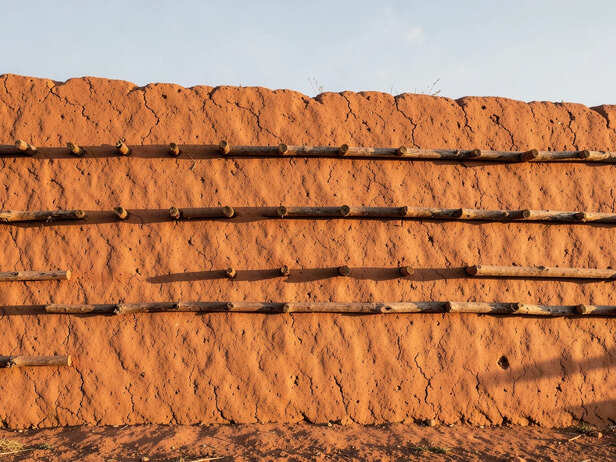
The Sahel has a sharp seasonal rhythm. The dry season runs roughly from October to May; the rains arrive in June and do not ease until September. In a fired-brick building, rain is a nuisance. In a banco building, it is a structural threat. Water penetrates the plaster surface, softens the brick beneath, and if left unchecked begins to erode the wall's load-bearing core. Cracks open. Pinnacles lean. The palm-wood torons, the wooden beams that protrude from the facade in rows and give the mosque its distinctive bristled look, allow the plaster to be anchored and also serve as the scaffolding for the replastering work itself. They are built into the design because the design assumes the work will happen.
This is the logic of banco construction: the building is not designed to resist maintenance. It is designed to receive it. The torons are not decorative afterthoughts. They are the reason the mosque can be climbed by hand, without external scaffolding, every single year.
The Crépissage: What the Gathering Looks Like
![Sahelian Earthen Wall Texture]()
Sahelian Earthen Wall Texture
Image credit : MyLifeXP Bureau
The annual replastering, called the crépissage in French, the language of the colonial administration that documented it, takes place in the dry season, typically in the weeks before the rains are expected. The date is not fixed to a calendar. It is read from the season.
In the days before the work begins, men and boys soak large quantities of banco in pits near the river, mixing it to the right consistency. The texture matters: too dry and it will not adhere; too wet and it will slide. On the day itself, the mosque's facade becomes a human scaffold. Men climb the torons from the base, passing buckets of wet mud up the line. Others spread it with their palms, pressing it into the surface and smoothing it in broad strokes. The work is loud. There is music. Food is brought by the women of the neighbourhood. The whole thing is closer to a festival than a construction site, and that is not incidental, the social energy is part of what makes it happen at the scale it requires.
The crépissage is organised by the masons' guild of Djenné, the Barey-ton, whose members hold both the technical knowledge and the ceremonial authority over the work. Membership passes through family lines. The specific knowledge of how thick to apply the plaster at the base versus the pinnacles, how to read a crack to know whether it is surface or structural, how to mix banco for the wall face versus the flat roof, this is accumulated across generations and is not written down.
Why the Building Looks the Way It Does
The mosque's form is not purely aesthetic. Every element of its surface is a response to what banco does under weather. The slight inward lean of the minarets sheds water away from the wall face. The rounded tops of the pinnacles reduce the surface area exposed to rain. The ostrich eggs at each tip are porous enough to allow moisture to escape rather than pool. The torons create shadow lines that slow surface drying and reduce cracking. The building has been shaped, over centuries, by the logic of its own maintenance.
This is what distinguishes Djenné's mosque from a ruin kept alive by restoration. A ruin is preserved in the state it reached when it stopped being used. The mosque has never stopped being used, and the form it holds today is the form that the accumulated knowledge of its builders has converged on as the one that survives. It is not a historical object. It is a living argument about how to build in this climate with this material.
What It Takes to Keep a Building Alive This Way
The crépissage depends on something that no engineering solution can substitute: a community that shows up. The mosque is a UNESCO World Heritage Site, and that designation has brought both attention and tension. Outside organisations have at various points proposed more durable synthetic coatings that would reduce the frequency of replastering. The masons' guild has consistently declined. The reasons are not only cultural, though they are that too. A synthetic coating applied over banco traps moisture rather than allowing it to migrate, which accelerates the internal deterioration the surface is meant to protect against. The guild's resistance is technically correct as well as traditional.
What the annual gathering sustains is not just a building. It sustains the knowledge of how to sustain the building. A generation that does not climb the torons does not learn to read a banco wall. The crépissage is the knowledge transfer mechanism. Skip it for long enough and the building becomes genuinely irreparable, not because the material has failed but because the people who know what to do with it are gone.
The mosque at Djenné is a useful corrective to the idea that permanence is what makes a building great. This one is great precisely because it is not permanent, because it asks something of the people who live near it every single year, and because they have answered for longer than most permanent buildings have stood.
Unlock insightful tips and inspiration on personal growth, productivity, and well-being. Stay motivated and updated with the latest at
My Life XP.