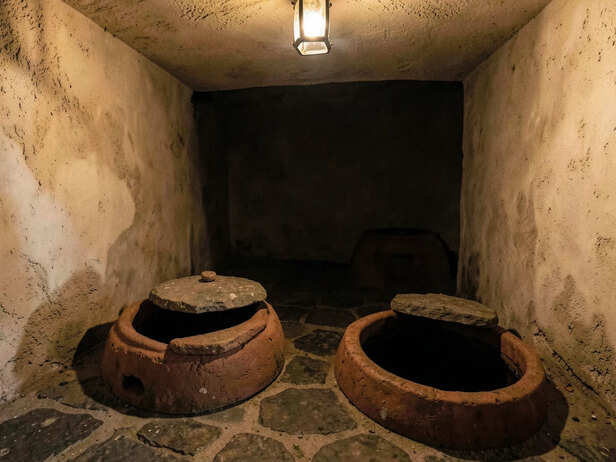
The cellar floor in a Georgian village house looks empty. Stone flags, a low ceiling, jars of pickled vegetables along one wall. Then your host points down, and you notice the mouth: a clay rim flush with the floor, sealed with a beeswax-coated stone lid, the top of something much larger buried beneath your feet. That buried vessel is a qvevri, and inside it, wine is either fermenting or ageing in conditions that have not changed in any meaningful way for eight millennia.
What a Qvevri Actually Is
![Ancient Georgian Wine Cellar]()
Ancient Georgian Wine Cellar
Image credit : MyLifeXP Bureau
A qvevri is a large egg-shaped vessel thrown from local clay, fired in a wood kiln, and coated on the inside with a thin layer of beeswax while still warm. The shape matters. The narrowing base concentrates grape solids, skins, seeds, stems, at the bottom during fermentation, then lets them settle and compact as the wine clears. No flat-bottomed tank does this as cleanly. Sizes range from a few hundred litres to several thousand, but the principle is the same at every scale: a sealed, thermally stable environment with no moving parts and no external energy input.
The vessel is buried to its shoulder or its neck in the earthen floor of a marani, the dedicated wine cellar found in most traditional Georgian homes. Burial keeps the interior at a steady cool temperature through both fermentation and the long ageing that follows. The earth does the work that a refrigeration unit does in a modern winery, and it does it without fluctuation.
The Fermentation Itself
Harvest in Georgia falls in autumn across the eastern wine region of Kakheti, where most qvevri wine is still made. Grapes are crushed and the entire contents, juice, skins, seeds, and often the grape stems, go into the vessel together. This is called skin-contact or amber winemaking in the language of contemporary natural wine, but in Kakheti it has no special name. It is simply how wine is made.
Wild yeasts living on the grape skins and in the winery air begin fermentation without any addition. The must heats slightly as it works. Because the qvevri is buried, that heat dissipates slowly and evenly into the surrounding earth rather than spiking the way it would in a vessel sitting in open air. The winemaker punches down the cap of skins twice a day for the first weeks, pushing the floating solids back into the liquid. After fermentation finishes, the vessel is sealed. The wine rests on its skins for anything from a few months to the better part of a year.
The extended skin contact extracts tannin, colour, and a class of compounds called phenolics that give qvevri wines their characteristic grip and amber hue. White grapes made this way produce wine that looks and behaves more like a light red than a conventional white. The tannin acts as a natural preservative, which is part of why these wines survive in sealed clay without sulphur additions.
What the Clay and Beeswax Do
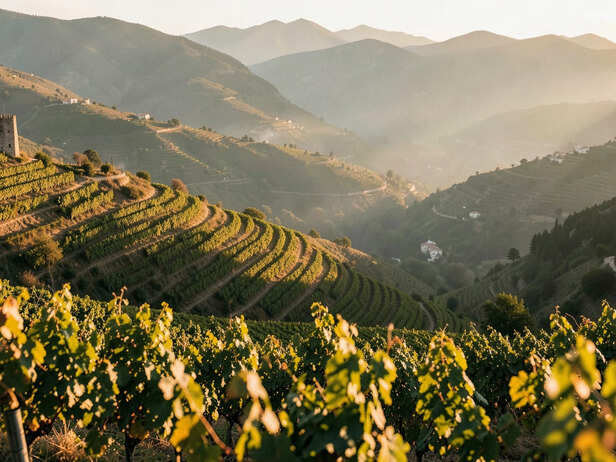
![Alazani Valley Golden Hour]()
Alazani Valley Golden Hour
Image credit : MyLifeXP Bureau
Fired clay is microscopically porous. A qvevri breathes, very slowly, the way an unglazed terracotta pot does. This micro-oxygenation softens tannins over time in the same way barrel ageing does, but more gently and without the wood flavour. The beeswax lining keeps the wine from absorbing mineral flavours from the clay itself while preserving that slow gas exchange.
After each vintage, the qvevri is emptied, scrubbed with water and cherry-tree branches, rinsed with lime solution, and inspected. A crack is repaired with a mixture of lime and egg white before the next harvest. A well-maintained qvevri lasts for generations. There are vessels in use in Georgia that are over a century old, still sound, still in annual service.
Where to See This in Georgia
The Alazani Valley in Kakheti stretches east from Tbilisi toward the Caucasus foothills, and almost every village along it has a marani. The town of Sighnaghi, walled and perched above the valley, has become a practical base for visiting working wineries. Several smaller villages, Shilda, Velistsikhe, Ikalto, have family operations where the marani is attached to the house and the qvevri are the ones a grandfather buried.
The Ethnographic Museum in Tbilisi keeps reconstructed examples above ground so you can see the full vessel shape, which is otherwise invisible when buried. Standing beside one, you understand the scale: the largest hold more than two thousand litres and are taller than a person. Moving one intact is not possible. They are made in place or lowered into a purpose-dug pit before the cellar floor is laid.
Why the Method Survived
Qvevri winemaking was inscribed on UNESCO's list of intangible cultural heritage in 2013, which brought international attention to a practice that had never actually stopped. Soviet collectivisation pushed wine production into industrial facilities during the twentieth century, but family cellars in rural Kakheti kept their buried vessels and their own grapes. When the industrial system collapsed, the knowledge was still there, held by people who had never stopped using it.
The method persists not because of heritage sentiment but because it works. The buried vessel maintains temperature without energy. The skin contact preserves without additives. The beeswax lining protects without flavour interference. Each element solves a real problem, and the solution requires nothing that cannot be made by hand from local materials. That is a different kind of durability than a stainless-steel tank offers.
The wine that comes out of a qvevri tastes like the place it was made in a way that is difficult to explain until you have stood in the marani where it was sealed and understood that the earth around the vessel is part of the process. The temperature holding the fermentation steady is the temperature of that specific ground. There is no analogue for that in a climate-controlled cellar, and no shortcut to it either.
.