A loin loom fits in a lap. One end of the warp is tied to a fixed post, a beam, a veranda pillar, a tree. The other end is looped around the weaver's lower back through a wide strap of woven cloth. She controls tension by leaning away. When she needs to rest, she leans in. The whole apparatus rolls up and goes indoors in under a minute. In Khonoma, a village of the Angami Naga people set into the hills above Kohima, this is how shawls have been made for as long as anyone has kept count.
The shawl that comes off this loom is not decoration. It is a document. The Angami have no traditional script, and for a long time the shawl carried what writing carries elsewhere, rank, lineage, event, identity. A man's shawl announced whether he had hosted a feast of merit, whether he had hunted, whether he belonged to a warrior class. A woman's shawl announced her clan and her skill. Reading the cloth was not a specialised knowledge. Everyone who wore one could read the ones around them.
The Loom Itself, and What It Demands
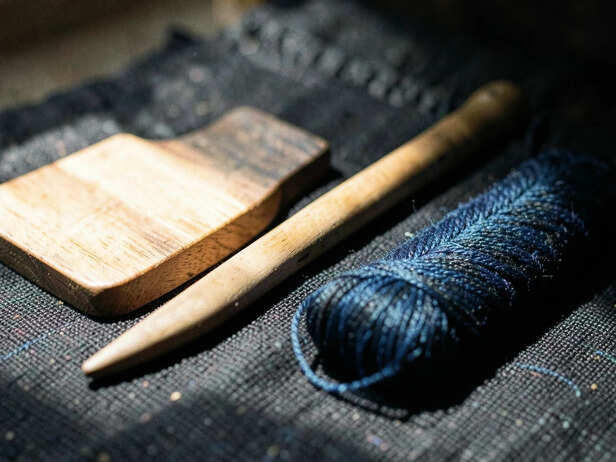
The loin loom is sometimes called a backstrap loom, and the name explains the mechanism: the weaver's body is the frame. She sits on the ground or on a low platform, legs extended, the warp threads running horizontally away from her. A heddle rod separates the warp threads into two layers, and a shed stick holds the gap open so the shuttle can pass through. She beats each new weft thread tight with a flat sword-shaped beater.
The tension is live. If she shifts her weight, the shed changes. If she leans too far back, threads snap. The learning curve is long, children in Khonoma are introduced to the loom young, but a weaver who can produce an even shed and a consistent beat across the full width of a ceremonial shawl has typically spent years arriving there. The cloth that results has a density and a hand that power-loomed imitations do not replicate, partly because the tension varies slightly across the width in a way that gives the finished piece a faint organic irregularity.
The width of a traditional Angami shawl is governed by the span of the weaver's arms, because the shuttle must pass by hand from one side to the other without the weaver standing. Most finished shawls sit between forty-five and sixty centimetres wide. Length is determined by the warp, which is set before weaving begins. A ceremonial shawl may take two to three weeks of sustained work.
What the Bands Are, and What They Record
![Loin Loom Essentials Unveiled]()
Loin Loom Essentials Unveiled
Image credit : MyLifeXP Bureau
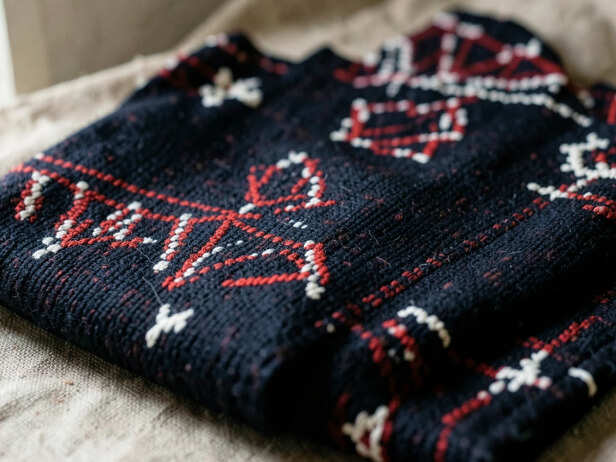
The surface of an Angami shawl is organised in horizontal bands of colour separated by narrower stripes. The background is almost always black or dark indigo, traditionally dyed with indigo grown locally, though chemical dyes have largely replaced it. Against that ground, the bands run in red, white, and occasionally yellow or green, in sequences that are not arbitrary.
The central band is typically the widest and carries the most complex patterning. In shawls associated with the feast of merit, the Angami practice of hosting progressively larger communal feasts, each conferring a higher social standing on the host, the central band widens with each feast completed. A man who had hosted the full sequence wore a shawl whose central field was broad enough to announce it without words.
Narrower bands carry clan markers. These are not secret, but they are specific: a particular arrangement of white stripes on red, or a particular spacing of chevron-like motifs woven in supplementary weft, identifies the weaver's family line to anyone from the same community. The motifs themselves, lozenges, zigzags, stepped triangles, are among the oldest geometric forms in South and Southeast Asian textile traditions, and similar shapes appear on loomed cloth from the hills of Manipur, Mizoram, and across into Myanmar. In Khonoma, they are not borrowed from a regional vocabulary; they are the local vocabulary, specific in their arrangement even when the shapes are shared.
Khonoma's Place in This Tradition
![Angami Shawl Texture Detail]()
Angami Shawl Texture Detail
Image credit : MyLifeXP Bureau
Khonoma sits about twenty kilometres from Kohima at roughly 1,500 metres. It is an Angami village with a particular reputation, it resisted British annexation longer than most, and it declared itself Asia's first green village in the 1990s, banning hunting and protecting its surrounding forest to bring back the Blyth's tragopan, a pheasant that had been hunted close to local extinction. The weaving tradition here is continuous in a way it is not everywhere in Nagaland, partly because the village's relative isolation preserved both the practice and the knowledge of what the patterns mean.
Women in Khonoma weave on their verandas in the cooler parts of the day. The shawls produced for daily use are simpler, fewer bands, less supplementary weft work. Ceremonial shawls are still made for weddings, for community occasions, and for the handful of families that continue to mark the feast of merit. The market for tourist-facing shawls exists and is visible in Kohima, but in Khonoma the distinction between a shawl made for sale and a shawl made for use is still legible to the people who live there.
What Is Being Lost and What Is Holding
The knowledge at risk is not the weaving itself, younger women in Khonoma do weave, and the loin loom has not disappeared. What is harder to transmit is the reading of the cloth: the specific understanding of which band belongs to which clan, which motif records which event, which shawl a person is entitled to wear and which they are not. That knowledge lives in the older weavers and in the community memory of the families who kept the feast tradition. Where it has not been written down, it is fragile.
Some documentation work has been done, by researchers from outside, by Nagaland's state craft bodies, by individual families who recognised what was slipping. The Nagaland Handloom and Handicrafts Development Corporation maintains records of tribal shawl patterns, and there are ongoing efforts to teach the grammar of the cloth alongside the technique of making it. Whether the reading survives as a living practice, rather than an archived one, depends on whether the occasions that give the shawl meaning, the feasts, the ceremonies, the community events where the right cloth matters, continue to be held.
The loom, the weaver, the post, and the strap: the shawl begins in that arrangement and carries forward everything the arrangement has accumulated. The bands are not ornament applied to cloth. They are the reason the cloth was made in the first place, and the loom is the reason the bands look the way they do, slightly uneven, dense, made under the weaver's own body weight, impossible to replicate by any other means.
Unlock insightful tips and inspiration on personal growth, productivity, and well-being. Stay motivated and updated with the latest at
My Life XP.