Walk any street in Lisbon for long enough and the walls begin to feel like a second city laid over the first. Facades that would be plain plaster anywhere else are covered, sometimes floor to ceiling, in hand-painted tin-glazed tiles. Churches carry entire biblical narratives across their interiors. Train station concourses tell the history of a region in panels the size of a room. The azulejo is so embedded in Lisbon's fabric that the city is genuinely harder to read without knowing what the tile is doing there and how it came to be.
Where the Word Comes From, and What It Actually Means
![Tile Making Essentials]()
Tile Making Essentials
Image credit : MyLifeXP Bureau
The name azulejo does not mean blue, though most people assume it does. It comes from the Arabic word for a small polished stone, and the tradition arrived in the Iberian Peninsula with Moorish craftspeople who had been making geometric tilework for centuries before Portugal existed as a country. Early Portuguese tiles were not painted at all, they were cut and arranged in interlocking geometric patterns, a technique called alicatado, borrowed directly from North African and Andalusian workshops. The blue-and-white palette that now defines the form came later, in the seventeenth century, when Portuguese traders brought Chinese porcelain home from the East and local tile painters began imitating it. Dutch Delftware, arriving through trade routes in the same period, pushed the palette further toward cobalt on white. By the time Lisbon was rebuilding after the 1755 earthquake, the azulejo had become the city's default surface material, practical, beautiful, and cheap enough to use at scale.
Why Tile Made Practical Sense in This Climate
The choice was not purely aesthetic. Lisbon sits on the Atlantic coast, where the air is damp for much of the year and where summer heat can be severe. A thick layer of tin-glazed ceramic on an exterior wall does several things at once. It reflects direct sun, keeping the interior cooler than plaster would. It sheds rain without absorbing it, which matters in a city where Atlantic storms arrive hard and fast. It does not fade the way paint does, and it does not grow mould the way untreated plaster does. A well-laid azulejo facade from the eighteenth century looks, in colour and surface, almost identical today to what it looked like when it was set. That durability is part of why the city kept using them, not sentiment, but the practical recognition that nothing else worked as well on these particular walls in this particular climate.
How a Single Tile Is Fired
![Palace Corridor Azulejo Grandeur]()
Palace Corridor Azulejo Grandeur
Image credit : MyLifeXP Bureau
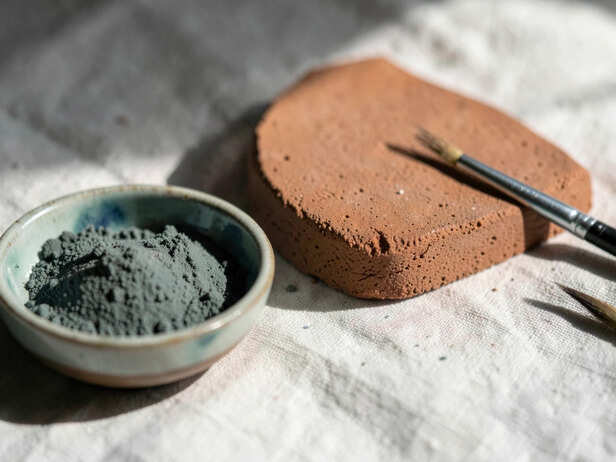
The process begins with a biscuit: a flat square of terracotta clay, fired once at high temperature until it is hard but still porous. That porosity matters. The next step is a bath in liquid tin glaze, a white, opaque coating that the biscuit absorbs evenly because of its open surface. Once dry, the glaze becomes a fragile, chalky white ground that a painter works on directly with metal-oxide pigments mixed to a consistency that the tile will drink in rather than sit on top of. There is no undoing a brushstroke. The glaze absorbs it immediately, and the painter works from memory and from a pricked paper cartoon, a pattern with holes punched along its lines, dusted with charcoal to transfer the outline onto the white surface. The painting is done dry, on a surface that feels like compressed chalk, with pigments that look nothing like their fired colour. Cobalt oxide, which fires to the deep blue of a classic azulejo, looks grey-green before the kiln. The painter has to know from experience what each pigment will become. A second firing at around 900 to 1000 degrees Celsius fuses the pigment into the glaze and the glaze into the biscuit, producing a surface that is now chemically stable and will not change again.
The Panel as a Record, Not Just a Picture
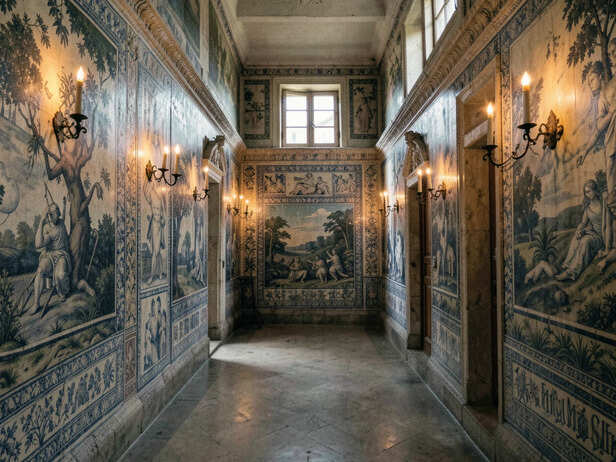
What makes Lisbon's azulejo tradition distinct from decorative tilework elsewhere is the scale at which it operates as narrative. A single tile is rarely the unit of meaning, the panel is. Eighteenth-century panels in Lisbon's palaces and churches run to hundreds of tiles, depicting hunting scenes, allegorical figures, the lives of saints, maps of estates, and views of the city as it looked before the 1755 earthquake destroyed much of it. Those pre-earthquake panels are among the only visual records of what central Lisbon looked like before the Marquis of Pombal's grid replaced it. The tile, in this sense, is an archive. It survived the earthquake and the fires that followed because it was already on the wall, fired hard, and because ceramic does not burn. The city's memory is partly stored in its tilework in a way that is not metaphorical, the panels contain information that exists nowhere else.
What Happens to Old Tiles When Buildings Fall Apart
Lisbon has a specific and uncomfortable relationship with azulejo loss. When a building is left to decay, and in some neighbourhoods, buildings have been left to decay for decades, the tiles come off the facade in sections and enter an informal market. Antique dealers, collectors, and tourists buy them. Some panels are removed deliberately before demolition and sold whole. The city has attempted, with mixed results, to regulate this, and there are ongoing debates about whether a tile belongs to the building, to the owner, or to the city's collective heritage. The National Tile Museum, housed in a former convent in the Xabregas neighbourhood, holds the most complete public collection and traces the full arc from geometric Moorish patterns to the industrial production of the twentieth century. It is the place where the history of the form is easiest to follow in sequence, and where the scale of what a panel requires, in time, in skill, in the number of individual firings, becomes clear in a way it cannot from a street.
The azulejo persists in Lisbon not because the city decided to preserve it as heritage but because it kept being the right answer to the same set of problems. The climate did not change. The walls still needed covering. The tile still worked. What changed, slowly, was the recognition that the panels also carry something harder to replace than insulation, a continuous visual record of how the city saw itself, century by century, pressed into fired clay and set into the walls for anyone walking past to read.
Unlock insightful tips and inspiration on personal growth, productivity, and well-being. Stay motivated and updated with the latest at
My Life XP.