Stand at the caldera edge in Fira or take a boat out to the middle of the bay, and the cliffs read like an open book, if you know the language. The striped wall dropping into the water is not one eruption's work. It is a stack of separate events, each one leaving a distinct material that hardened, was buried, and was eventually cut open by the collapse that made the bay itself.
The Caldera Wall Is a Cross-Section, Not a Surface
![Santorini Caldera Geological Layers]()
Santorini Caldera Geological Layers
Image credit : MyLifeXP Bureau
When the enormous eruption now called the Minoan eruption tore the centre out of the island roughly 3,600 years ago, it did not destroy a single volcano. It exposed the inside of one that had been building for several hundred thousand years. The steep inner wall of the caldera is that interior, sliced open and left standing. What you see from a boat is not the outside of a cliff. It is a geological cross-section, with the oldest material at the bottom and the most recent at the top.The total height of the exposed wall varies by section, reaching around 300 metres in places. Each horizontal band represents a period of volcanic activity followed by a pause long enough for the material to consolidate before the next event buried it.
The Dark Base: The Oldest Lavas
The lowest visible layer, darkest in colour and hardest in texture, is composed of ancient lava flows and solidified intrusions, material that was once liquid rock moving slowly rather than erupting explosively. These basaltic and andesitic formations are the oldest exposed part of the island's volcanic history, laid down when the seamount that would eventually become Santorini was still building itself up from the seafloor.This layer is not always easy to see from the rim. From a boat close to the base of the wall, it appears as a dense, almost black band, fractured and irregular compared to the smoother layers above it. It predates the island's recognisable shape by a significant margin.
The White and Cream Bands: Pumice and Ash Falls
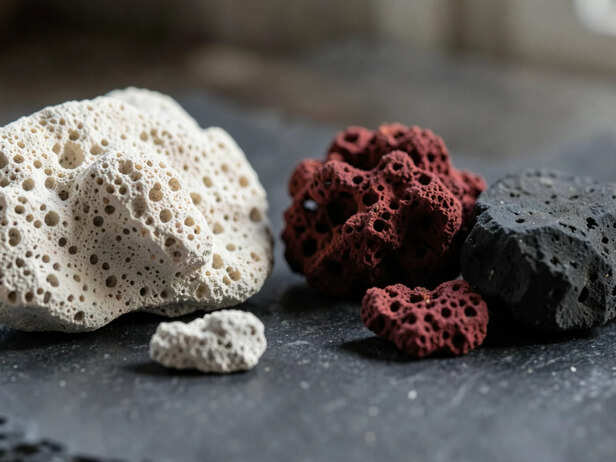
![Volcanic Rock Textures]()
Volcanic Rock Textures
Image credit : MyLifeXP Bureau
Above the dark base, the cliff lightens dramatically. The pale bands, white, cream, pale yellow, are layers of pumice and volcanic ash deposited during explosive eruptions. Pumice forms when gas-rich magma is blasted into the air and cools so quickly that it traps the gas inside, leaving a rock light enough to float on water.Several distinct pale bands are visible in the caldera wall, and they do not all come from the same event. Volcanologists working on Santorini have identified at least twelve significant eruption cycles in the island's history. The thickest and most prominent white layer near the top of the cliff is the deposit left by the Minoan eruption, the one that ended the Bronze Age settlement on the island and very likely contributed to the decline of Minoan civilisation on Crete. That layer can reach 30 to 60 metres thick in some sections of the wall.Below it, earlier pale bands mark earlier explosive events. Each is separated from the next by a thin darker line, a soil horizon or a lava flow that formed during the quiet interval between eruptions.
The Red and Brown Layers: Scoria and Oxidised Material
Between the pale ash bands, the cliff shows bands of deep red, rust, and brown. These are layers of scoria, a coarser, heavier volcanic material full of gas bubbles but denser than pumice, and of lava flows that oxidised as they cooled slowly in contact with air and groundwater.The red colour comes from iron in the rock reacting with oxygen over time. A bright red band in the cliff wall generally indicates a period when lava was flowing rather than being blasted explosively, and when the surface of that flow had time to weather before the next eruption buried it. The island of Palea Kameni, the older of the two small islands sitting in the middle of the caldera, is largely composed of this kind of material from eruptions that post-date the Minoan event.
The Dark Cap: The Most Recent Activity
The top of the caldera wall, where the villages of Fira, Imerovigli, and Oia sit, is capped by the youngest material. This includes lava and ash from eruptions that occurred after the Minoan collapse, as the volcanic system began rebuilding itself inside the flooded caldera. The dark, rough-surfaced cap is geologically recent, in volcanic terms, and is the layer the towns are built on.Nea Kameni, the younger central island, is entirely composed of material from eruptions since roughly the first century. It is still volcanically active and has grown measurably within recorded history, most recently after eruptions in the twentieth century. Standing on its surface and looking back at the caldera wall, you are standing on the youngest layer of the sequence while looking at the oldest.
How to Read the Wall from the Water
The best reading position is a boat in the middle of the caldera, ideally in the morning when the sun is still low and raking across the cliff face from the east. The horizontal banding becomes sharp enough to count the major layers. From bottom to top: dark ancient lava, alternating pale ash and red scoria bands representing the pre-Minoan eruption cycles, the thick dominant white of the Minoan deposit, and the dark recent cap.From the rim, the wall is harder to read because you are looking down at a foreshortened angle. The boat view gives you the full sequence as a readable column. The cliffs at Akrotiri on the southern tip show some of the clearest layering because the wall there is more directly lit and less interrupted by later construction.The sequence does not lie. Every band is a specific event that left a specific material, and the gap between two bands is a period of quiet that can sometimes be measured in centuries. The island is not old in the way a mountain range is old. It is young, restless, and still adding pages.
Unlock insightful tips and inspiration on personal growth, productivity, and well-being. Stay motivated and updated with the latest at
My Life XP.