Why Did This 3,000 Year Old Surgical Technique Avoid Needles Completely?
Noopur Kumari | Sun, 15 Feb 2026
This article explores the astonishing surgical technique attributed to Sushruta, where ants were used as natural clamps to seal wounds. Rooted in the knowledge of the Sushruta Samhita, this method reflects advanced medical understanding centuries before modern tools existed. Through five focused sections, discover how ancient Indian surgery balanced science and nature, why this technique worked, and how it continues to inspire discussions in medical history. Written in simple yet authoritative language, this piece blends curiosity with credible insight.

modern surgical tools
Image credit : ChatGPT(Ai)
Long before modern surgical tools and sterile operating rooms, ancient India recorded advanced medical innovation in texts like the Sushruta Samhita. Nearly 3,000 years ago, a battlefield surgeon faced a critical abdominal injury where stitching risked deadly infection. Instead of metal sutures, this technique, attributed to Sushruta, used natural methods that aligned with the body’s healing process. Revered as the Father of Surgery, Sushruta documented precise surgical principles, hygiene practices, and anatomical knowledge. His work reflects experience, expertise, and early scientific reasoning, showing how ancient Indian medicine combined observation, innovation, and respect for nature to save lives.
![Ancient Battlefield Surgery]()
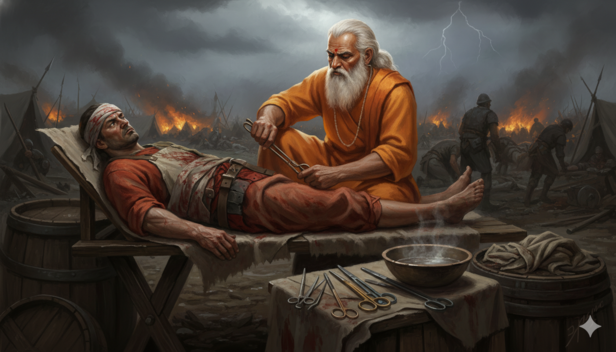
On an ancient battlefield, a soldier suffered a deep abdominal wound. His intestines were exposed and fragile. Using a needle could create punctures and leakage, leading to certain death. The situation demanded a solution that would hold the wound without piercing delicate tissue. Ancient surgeons understood that internal leakage meant fatal infection. According to traditional accounts linked to Sushruta, the answer was not metal or thread, but something living and precise. This moment highlights the urgency and brilliance behind early surgical innovation in India.
The surgeon reportedly brought forest ants to the wound. By aligning the edges of the cut and allowing an irritated ant to bite across them, its jaws locked tightly. Once clamped, the body of the ant was removed, leaving the head attached like a natural staple. This process was repeated along the wound. The method avoided puncturing tissue with metal. The ant’s bite created a firm hold without additional tearing. Such techniques show deep anatomical knowledge and practical understanding of wound management described in ancient Indian medical tradition.
![Nature Guided Healing]()
One remarkable aspect of this technique was its organic nature. Unlike foreign metal objects, the ant’s head was biodegradable. The body could tolerate it without strong rejection. As the wound healed, the natural clamps loosened and fell away. Ancient practitioners recognized that healing required harmony with the body’s processes. While modern medicine uses sterile sutures, this early method demonstrated awareness of tissue response and infection control. It reflected a medical philosophy that worked with biology rather than against it.
![Wisdom of Sushruta]()
The Sushruta Samhita documents advanced surgical procedures including wound care, plastic surgery, and anatomical study. Attributed to Sushruta, this text is considered foundational in the history of surgery. It emphasizes cleanliness, precision, and observation. While interpretations of specific battlefield techniques vary among historians, the broader surgical expertise described in the text is well recognized. Scholars worldwide acknowledge Sushruta’s contribution to medical science, reinforcing the credibility of ancient Indian surgical knowledge.
This story symbolizes a larger philosophy. Ancient Indian medicine believed nature held solutions for human suffering. Instead of forcing artificial tools into fragile tissue, the surgeon used the precision of an insect’s jaw. Whether viewed as literal history or symbolic innovation, the lesson remains powerful. Science and nature were not enemies but partners. The legacy of Sushruta continues to inspire medical historians and practitioners who value observation, adaptation, and respect for biological systems. It reminds us that innovation often begins with understanding the natural world.
Unlock insightful tips and inspiration on personal growth, productivity, and well-being. Stay motivated and updated with the latest at My Life XP
1. Who was Sushruta?
Sushruta was an ancient Indian physician and surgeon, widely regarded as the Father of Surgery. He is credited with documenting advanced surgical techniques, anatomical studies, and medical ethics in early Indian history.
2. What is the Sushruta Samhita?
The Sushruta Samhita is a foundational medical text of Ayurveda. It describes surgical instruments, wound management, plastic surgery, and hygiene principles that were far ahead of their time.
3. Did ancient Indian surgeons really perform complex surgeries?
Yes. Historical and scholarly research confirms that ancient Indian surgeons performed procedures such as cataract surgery, fracture treatment, and reconstructive surgery, based on documented techniques in classical texts.
4. Why is Sushruta called the Father of Surgery?
He systematically classified surgical instruments, explained detailed procedures, and emphasized training and cleanliness. His structured approach reflects early scientific methodology.
5. Is Sushruta’s work recognized globally?
Yes. Medical historians and scholars worldwide acknowledge Sushruta’s contributions as a major milestone in the history of global surgery.
A Battlefield Emergency
Ancient Battlefield Surgery
Image credit : GOOGLE STUDIO AI
On an ancient battlefield, a soldier suffered a deep abdominal wound. His intestines were exposed and fragile. Using a needle could create punctures and leakage, leading to certain death. The situation demanded a solution that would hold the wound without piercing delicate tissue. Ancient surgeons understood that internal leakage meant fatal infection. According to traditional accounts linked to Sushruta, the answer was not metal or thread, but something living and precise. This moment highlights the urgency and brilliance behind early surgical innovation in India.
The Science Behind the Ant Technique
Organic Healing Without Rejection
Nature Guided Healing
Image credit : Freepik
One remarkable aspect of this technique was its organic nature. Unlike foreign metal objects, the ant’s head was biodegradable. The body could tolerate it without strong rejection. As the wound healed, the natural clamps loosened and fell away. Ancient practitioners recognized that healing required harmony with the body’s processes. While modern medicine uses sterile sutures, this early method demonstrated awareness of tissue response and infection control. It reflected a medical philosophy that worked with biology rather than against it.
Knowledge from the Sushruta Samhita
Wisdom of Sushruta
Image credit : Freepik
The Sushruta Samhita documents advanced surgical procedures including wound care, plastic surgery, and anatomical study. Attributed to Sushruta, this text is considered foundational in the history of surgery. It emphasizes cleanliness, precision, and observation. While interpretations of specific battlefield techniques vary among historians, the broader surgical expertise described in the text is well recognized. Scholars worldwide acknowledge Sushruta’s contribution to medical science, reinforcing the credibility of ancient Indian surgical knowledge.
When Nature Became the Surgeon’s Tool
Unlock insightful tips and inspiration on personal growth, productivity, and well-being. Stay motivated and updated with the latest at My Life XP
Frequently Asked Questions (FAQs)
Sushruta was an ancient Indian physician and surgeon, widely regarded as the Father of Surgery. He is credited with documenting advanced surgical techniques, anatomical studies, and medical ethics in early Indian history.
2. What is the Sushruta Samhita?
The Sushruta Samhita is a foundational medical text of Ayurveda. It describes surgical instruments, wound management, plastic surgery, and hygiene principles that were far ahead of their time.
3. Did ancient Indian surgeons really perform complex surgeries?
Yes. Historical and scholarly research confirms that ancient Indian surgeons performed procedures such as cataract surgery, fracture treatment, and reconstructive surgery, based on documented techniques in classical texts.
4. Why is Sushruta called the Father of Surgery?
He systematically classified surgical instruments, explained detailed procedures, and emphasized training and cleanliness. His structured approach reflects early scientific methodology.
5. Is Sushruta’s work recognized globally?
Yes. Medical historians and scholars worldwide acknowledge Sushruta’s contributions as a major milestone in the history of global surgery.